


Sometimes, a single slide can explain more than a long report. Points and Figures is our way of breaking down what India’s leading companies are telling their shareholders and analysts. We comb through the decks, pull out the charts and data points that actually matter, and highlight the signals behind the numbers—whether about growth plans, margins, new markets, or risks on the horizon.
This is an extension of The Chatter. While The Chatter focuses on management commentary and earnings call transcripts, Points and Figures dives into investor presentations—and soon, even annual reports—to decode what companies are showing, not just what they’re saying.
We go through every major investor presentation so you don’t have to—bringing you the sharpest takeaways that reveal not just what the company is saying, but what it really means for the business, its sector, and the broader economy.
In this edition, we have covered 16 companies across 10 industries.
Software Services
Infosys
Engineering & Capital Goods
Pritika Auto Industries
Prostarm Info Systems
Quadrant Future Tek
SPML Infra
Shakti Pumps
Textiles
Indian Terrain Fashions
Metals
MMP Industries
Media & Entertainment
Dachepalli Publishers
Auto Ancillary
Tenneco Clean Air India
Chemicals
Polyplex Corporation
FMCG
Britannia Inds
Radico Khaitan
Financial Services
CRISIL
KFin Technologies
Tourism & Hospitality
Indian Hotel
Software Services
Infosys | Large Cap | Software Services
Infosys is a global leader in next-generation digital services and consulting, facilitating clients worldwide in their digital transformation journey. With over 40 years of experience, Infosys leverages cloud and AI technologies to empower businesses with agile digital solutions and continuous improvement. The company is dedicated to promoting diversity, sustainability, and innovation in an inclusive work environment.
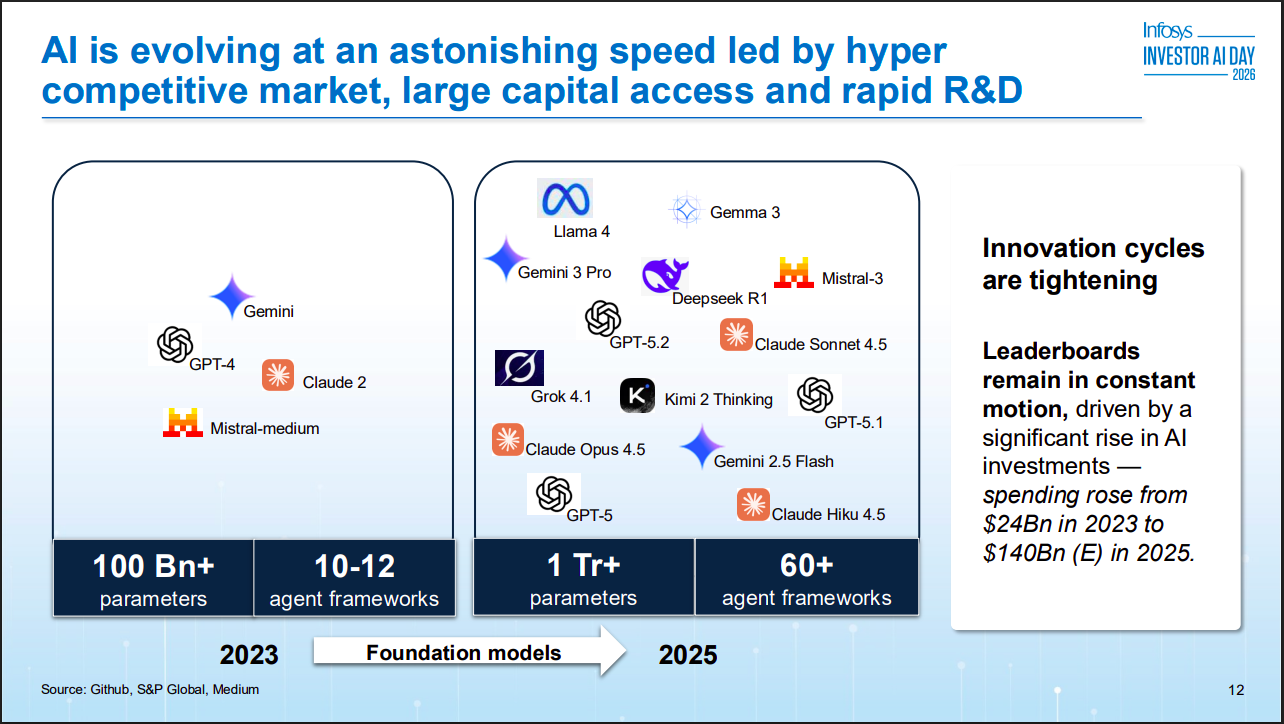
AI innovation has accelerated dramatically between 2023 and 2025, with model sizes expanding from ~100B+ parameters to 1T+ and agent frameworks rising from 10–12 to 60+. Rapid R&D, intense competition, and capital inflows are compressing innovation cycles, with AI spending projected to surge from $24Bn (2023) to ~$140Bn by 2025E.
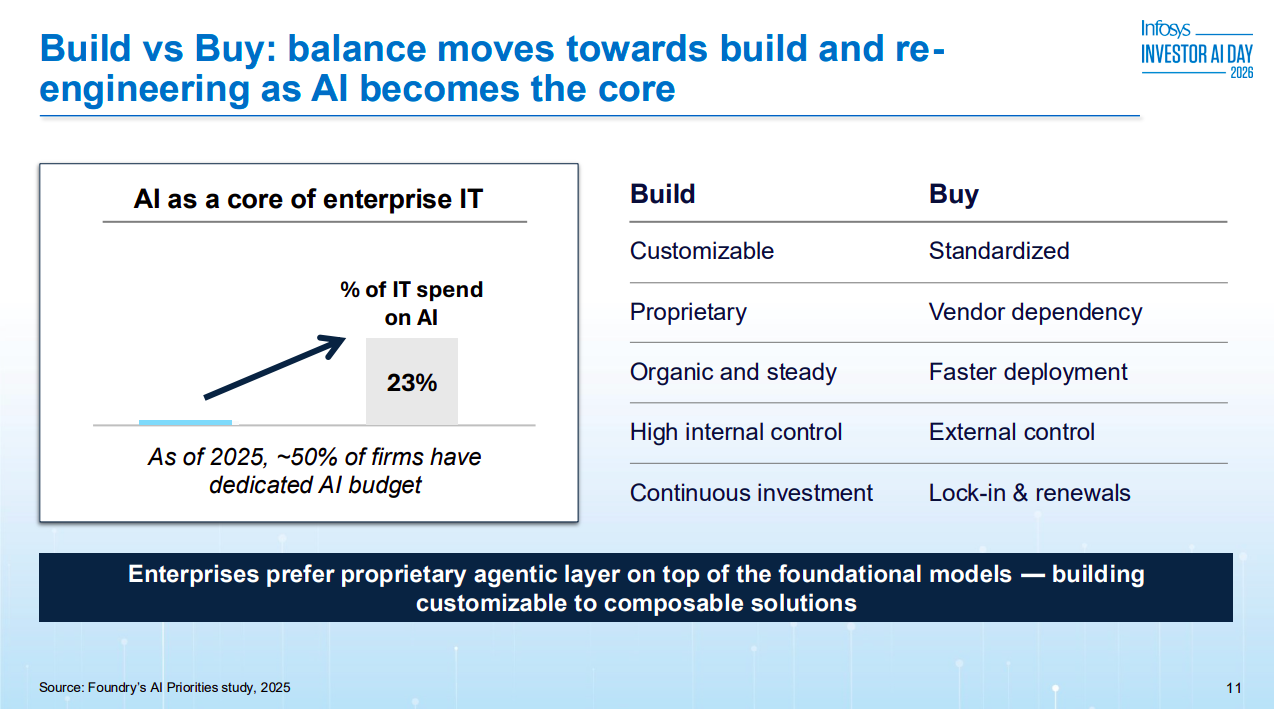
AI is becoming central to enterprise IT, now accounting for ~23% of IT spend, with ~50% of firms allocating dedicated AI budgets. The balance is shifting toward “Build” models for customization, control, and proprietary advantage rather than standardized vendor-led “Buy” solutions.
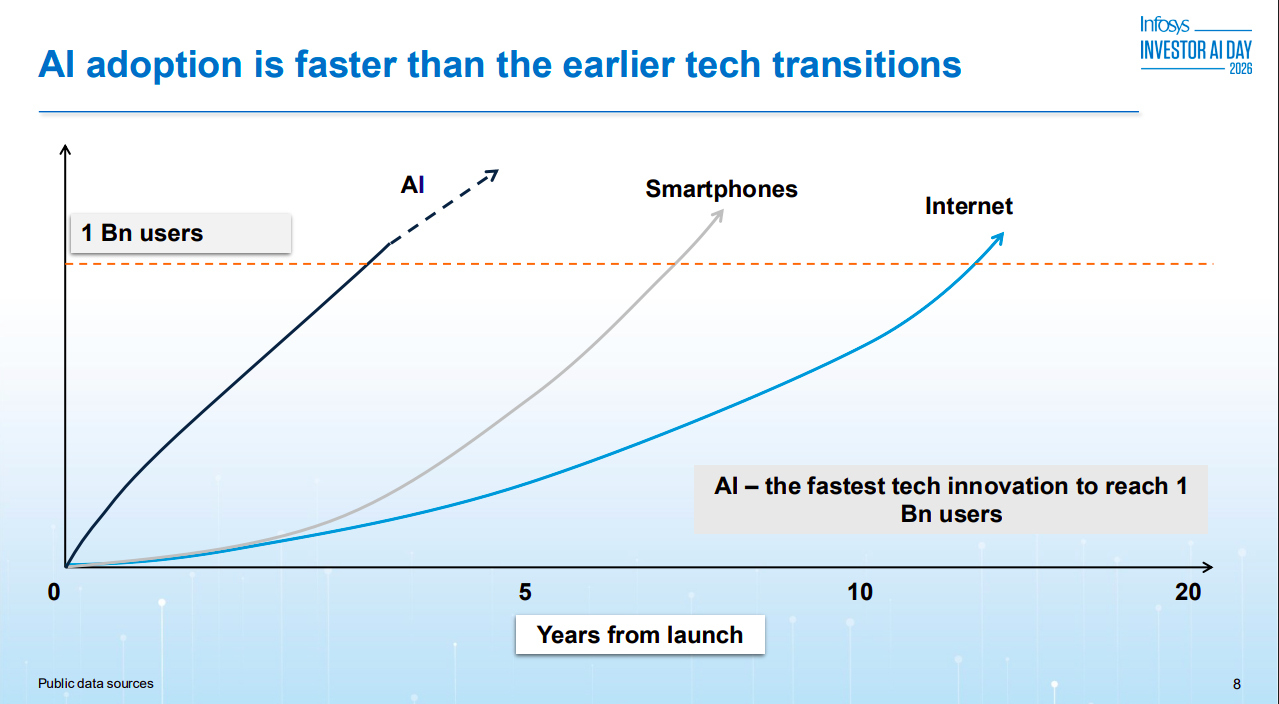
AI is on track to become the fastest technology to reach 1 billion users, outpacing smartphones and the internet. The adoption curve is significantly steeper, highlighting unprecedented diffusion speed.
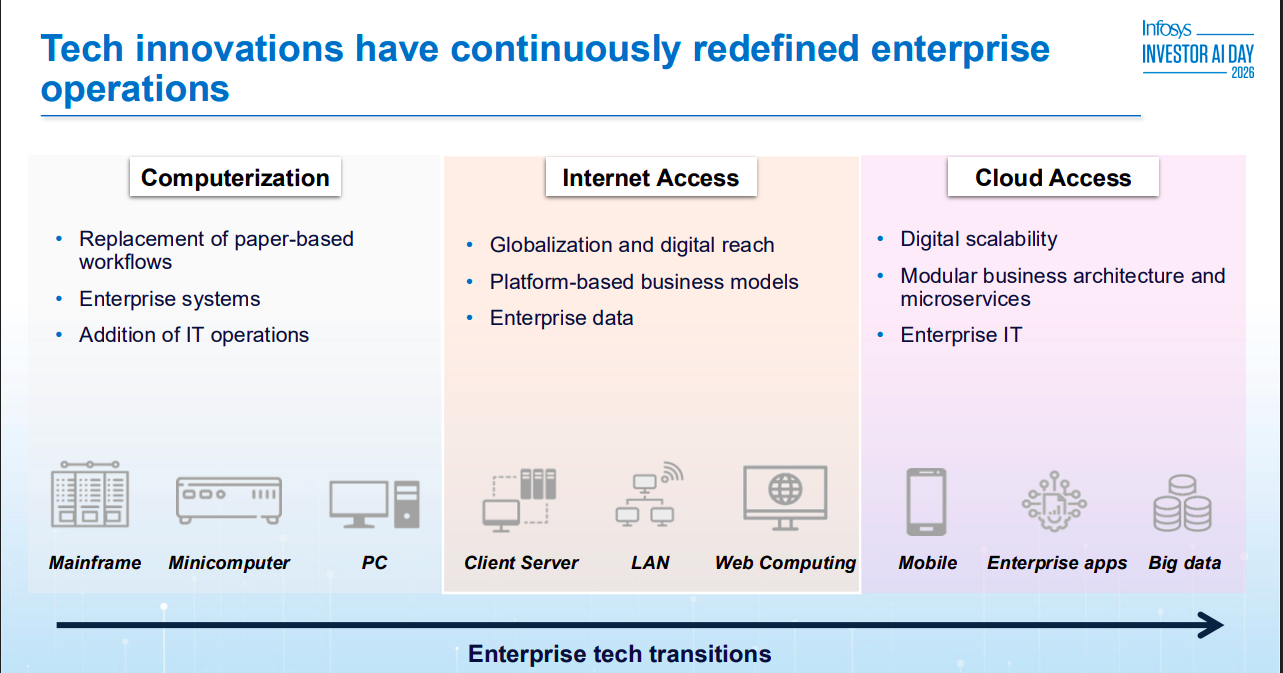
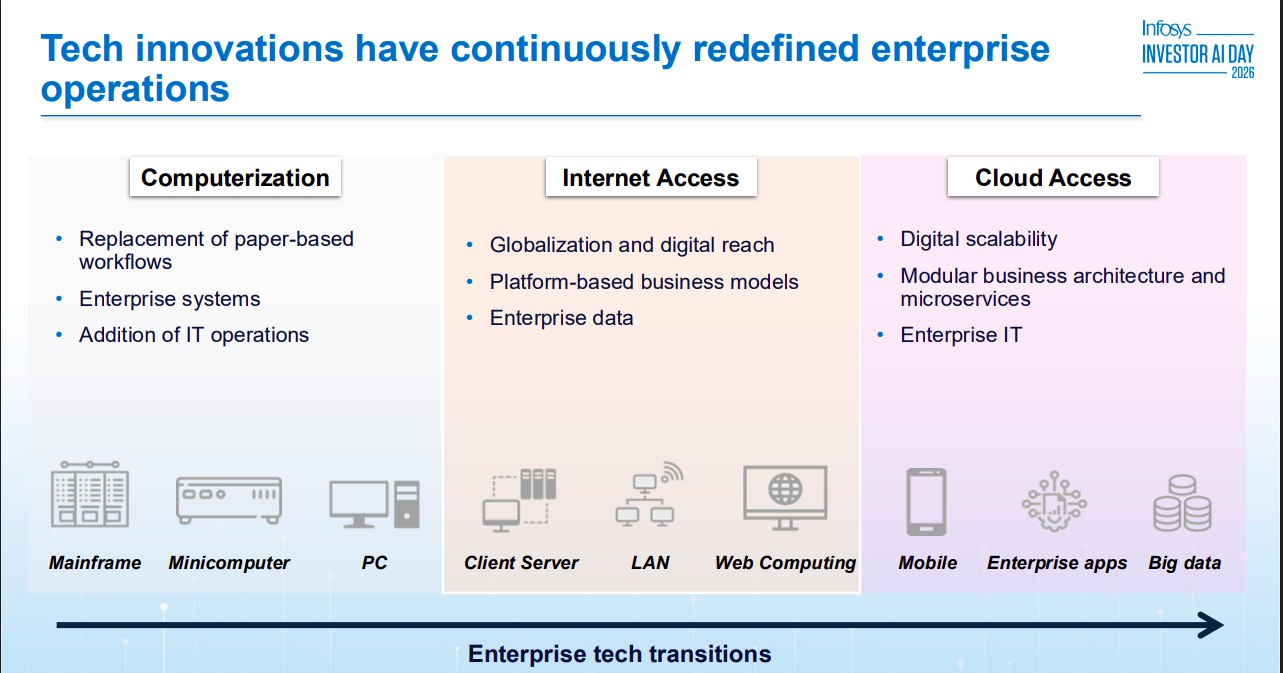
Enterprise IT has evolved from computerization (mainframes → PCs) to internet-based models (client-server, web) and then cloud-based digital scalability. Each transition reshaped enterprise architectures, culminating in modular, scalable cloud ecosystems.
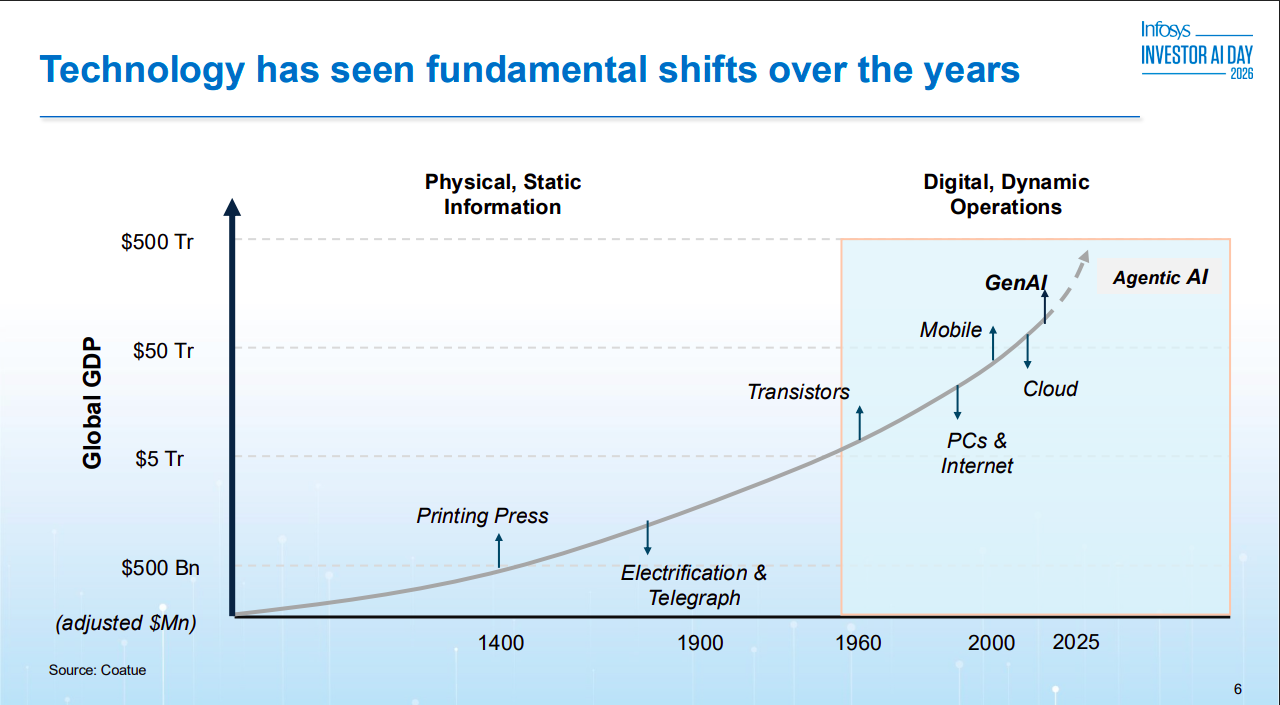
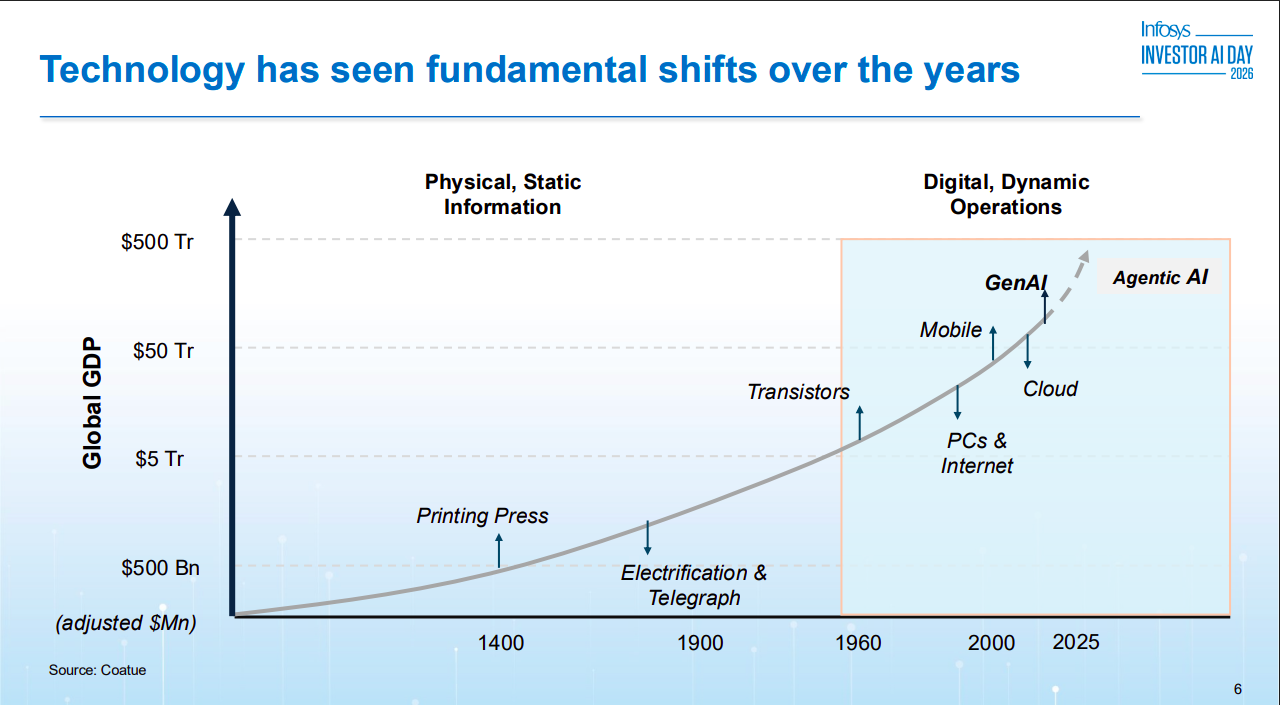
Technology waves—from the printing press to electrification, PCs, cloud, GenAI, and now agentic AI—have continuously expanded economic output. The shift from physical/static systems to digital/dynamic operations is accelerating GDP impact in the modern era.
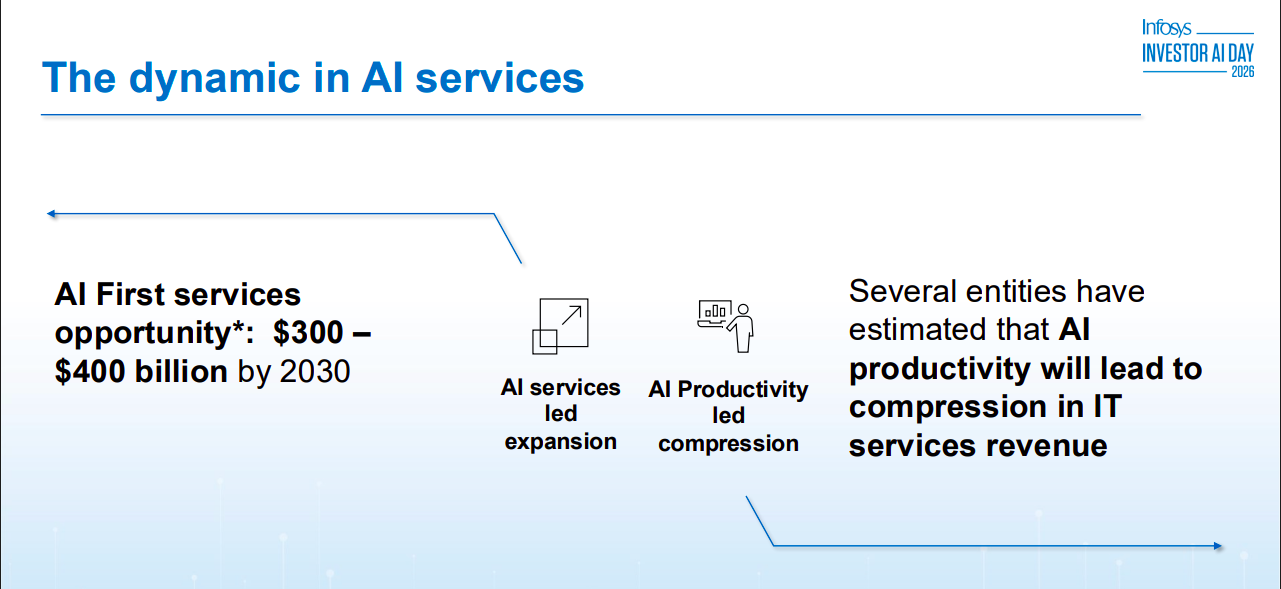
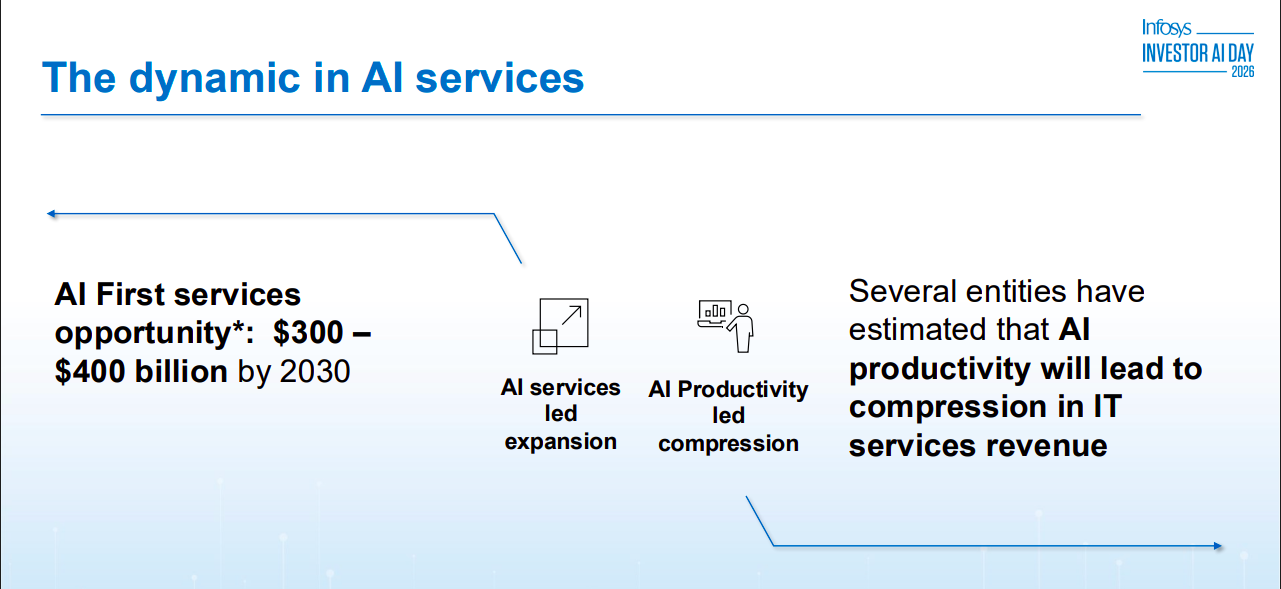
AI-first services are estimated to create a $300–400 billion opportunity by 2030, driven by AI-led expansion. However, rising AI productivity may also compress traditional IT services revenue, creating a dual impact of growth and margin pressure.
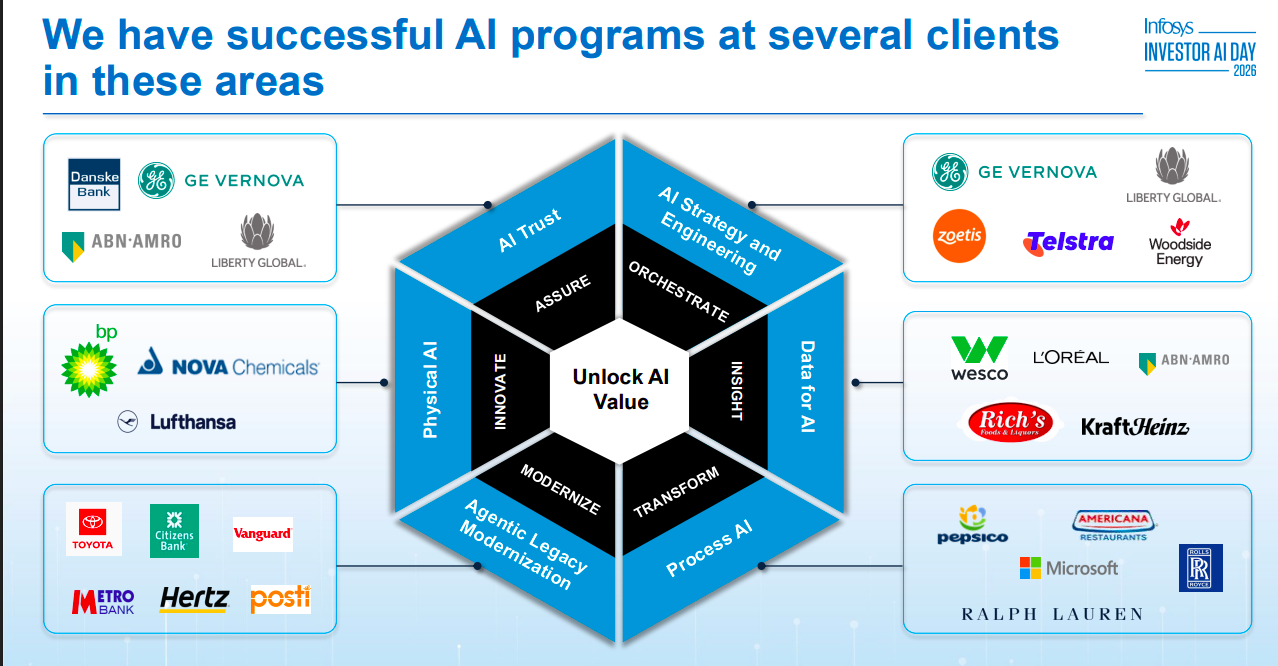
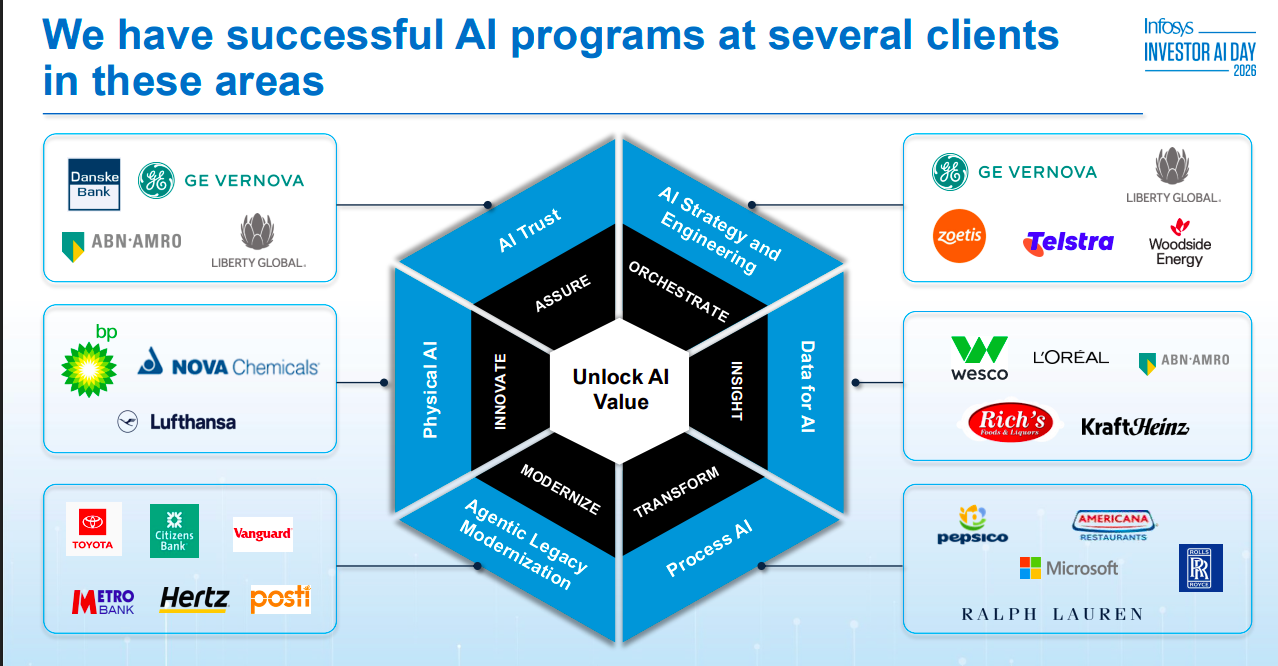
Infosys highlights enterprise AI engagements spanning AI Trust, AI Strategy & Engineering, Data for AI, Process AI, and modernization. The slide showcases broad client adoption across industries, demonstrating end-to-end AI value unlock capabilities.
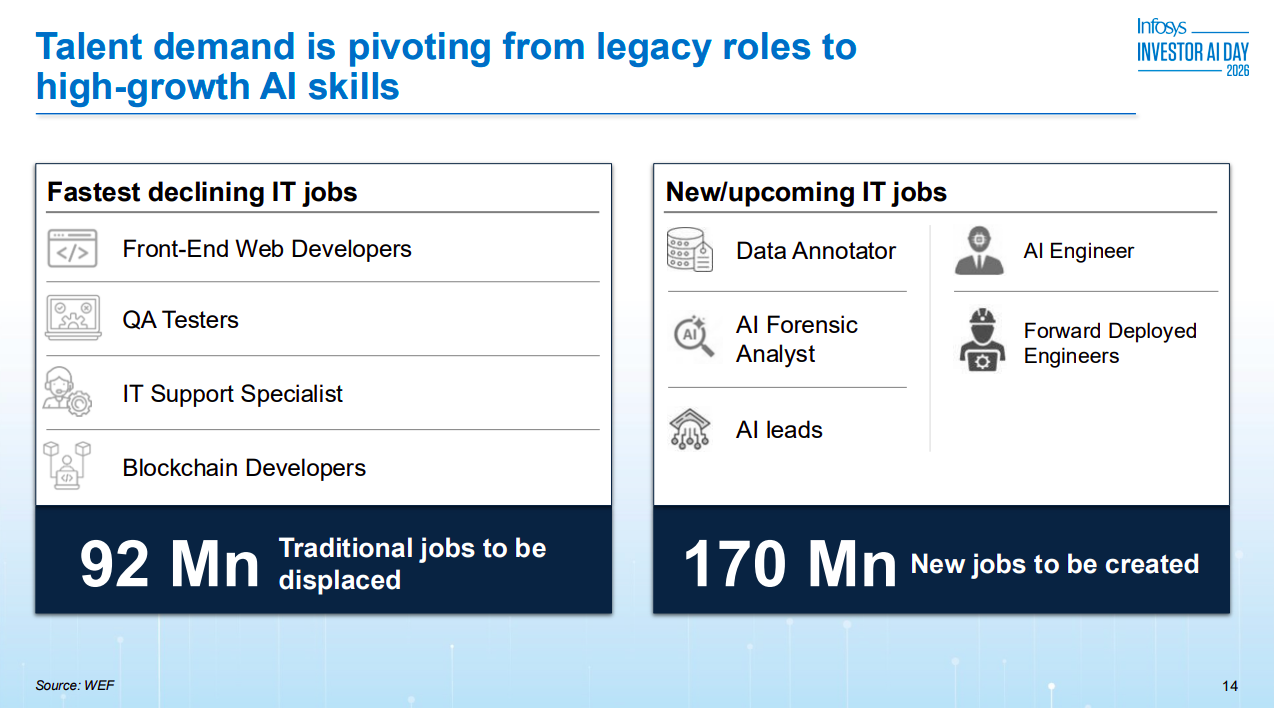
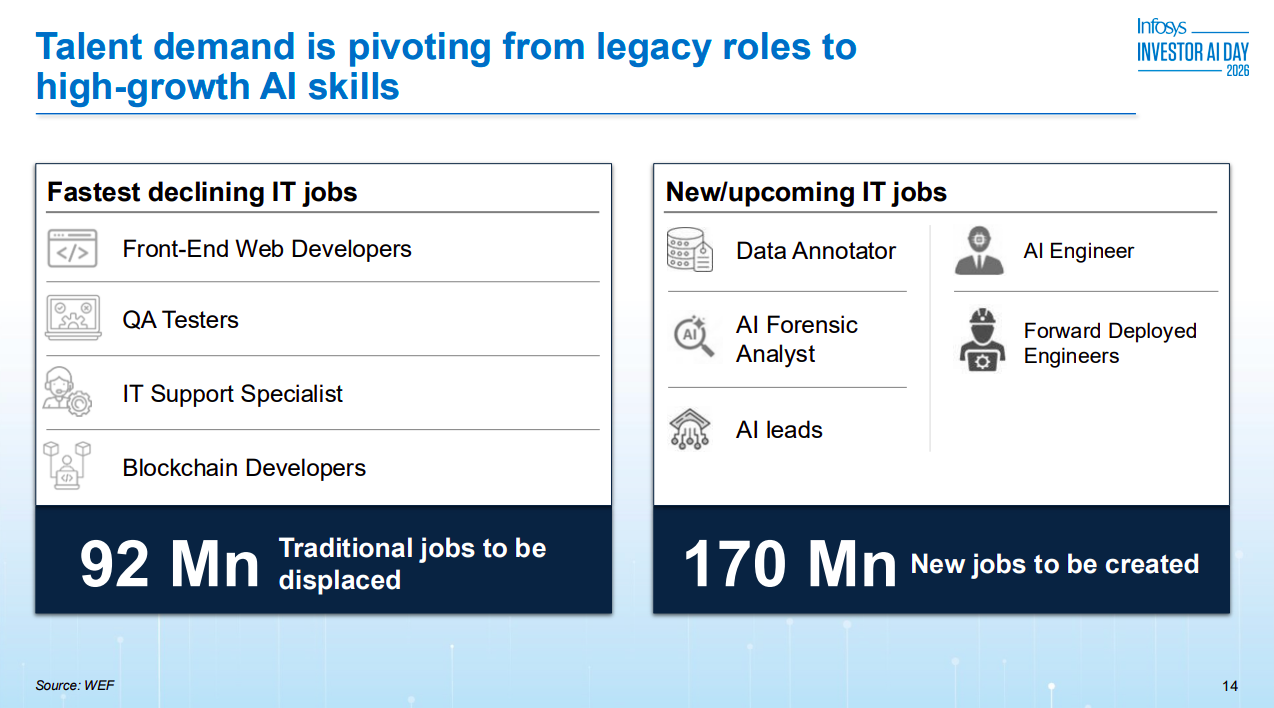
Legacy IT roles such as front-end developers, QA testers, and IT support are declining, with ~92 million traditional jobs expected to be displaced. At the same time, 170 million new roles—such as AI engineers, data annotators, AI forensic analysts, and forward-deployed engineers—are projected to emerge, signaling a major skills transition.
Enterprise IT has evolved from computerization (mainframes → PCs) to internet-based models (client-server, web) and then cloud-based digital scalability. Each transition reshaped enterprise architectures, culminating in modular, scalable cloud ecosystems.
Technology waves—from the printing press to electrification, PCs, cloud, GenAI, and now agentic AI—have continuously expanded economic output. The shift from physical/static systems to digital/dynamic operations is accelerating GDP impact in the modern era.
AI-first services are estimated to create a $300–400 billion opportunity by 2030, driven by AI-led expansion. However, rising AI productivity may also compress traditional IT services revenue, creating a dual impact of growth and margin pressure.
Infosys highlights enterprise AI engagements spanning AI Trust, AI Strategy & Engineering, Data for AI, Process AI, and modernization. The slide showcases broad client adoption across industries, demonstrating end-to-end AI value unlock capabilities.
Legacy IT roles such as front-end developers, QA testers, and IT support are declining, with ~92 million traditional jobs expected to be displaced. At the same time, 170 million new roles—such as AI engineers, data annotators, AI forensic analysts, and forward-deployed engineers—are projected to emerge, signaling a major skills transition.
Engineering & Capital Goods
Pritika Auto Industries | Nano Cap | Engineering & Capital Goods
Pritika Auto Industries Limited was incorporated in 1980 having its registered office in Punjab, India. The company is engaged in the manufacturing of tractor and automobile components. The Target Company also provides engineering and allied services to its clients.
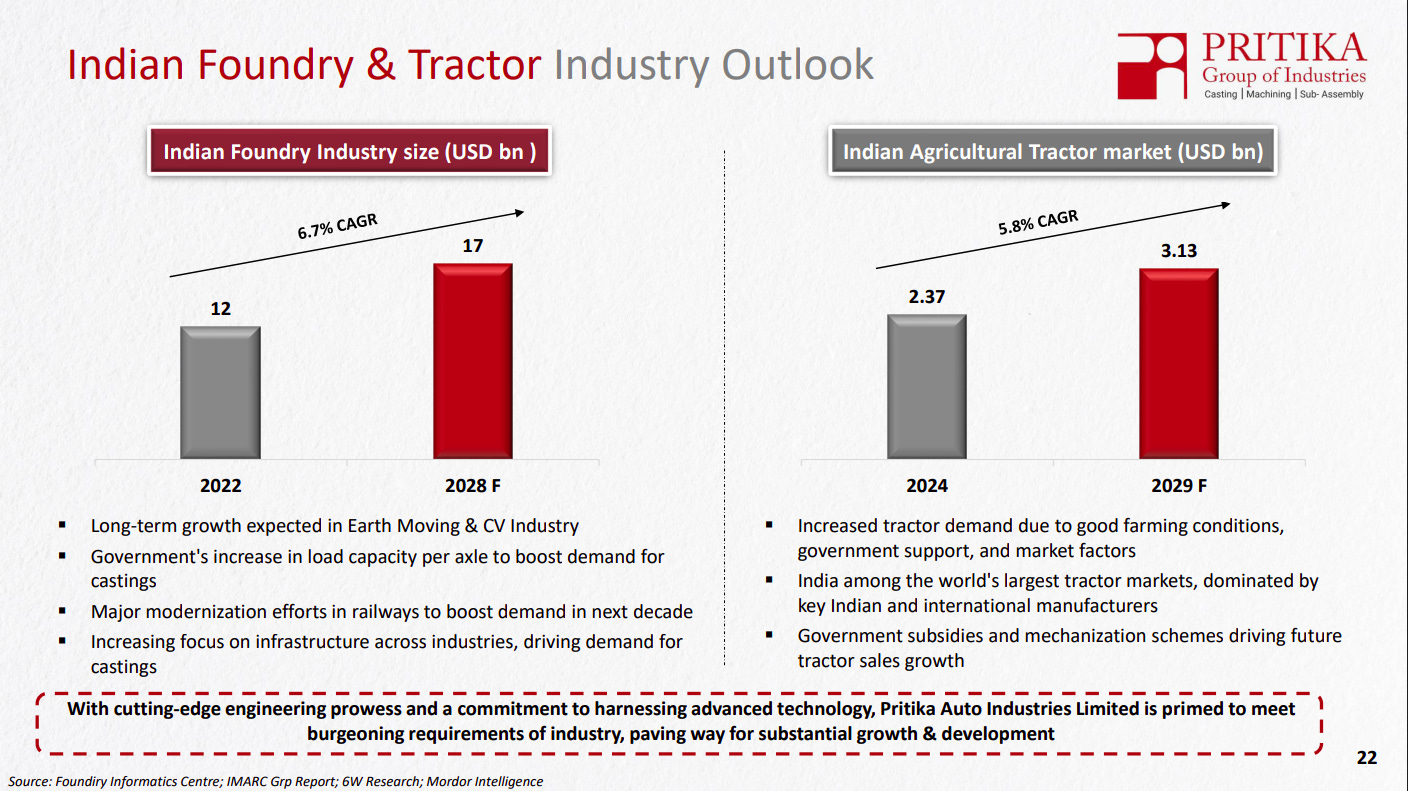
The Indian foundry industry is projected to grow from USD 12 bn in 2022 to USD 17 bn by 2028 (6.7% CAGR), supported by infrastructure push, rail modernization, and higher axle load norms. The tractor market is expected to rise from USD 2.37 bn in 2024 to USD 3.13 bn by 2029 (5.8% CAGR), driven by favorable farm conditions, subsidies, and mechanization trends.
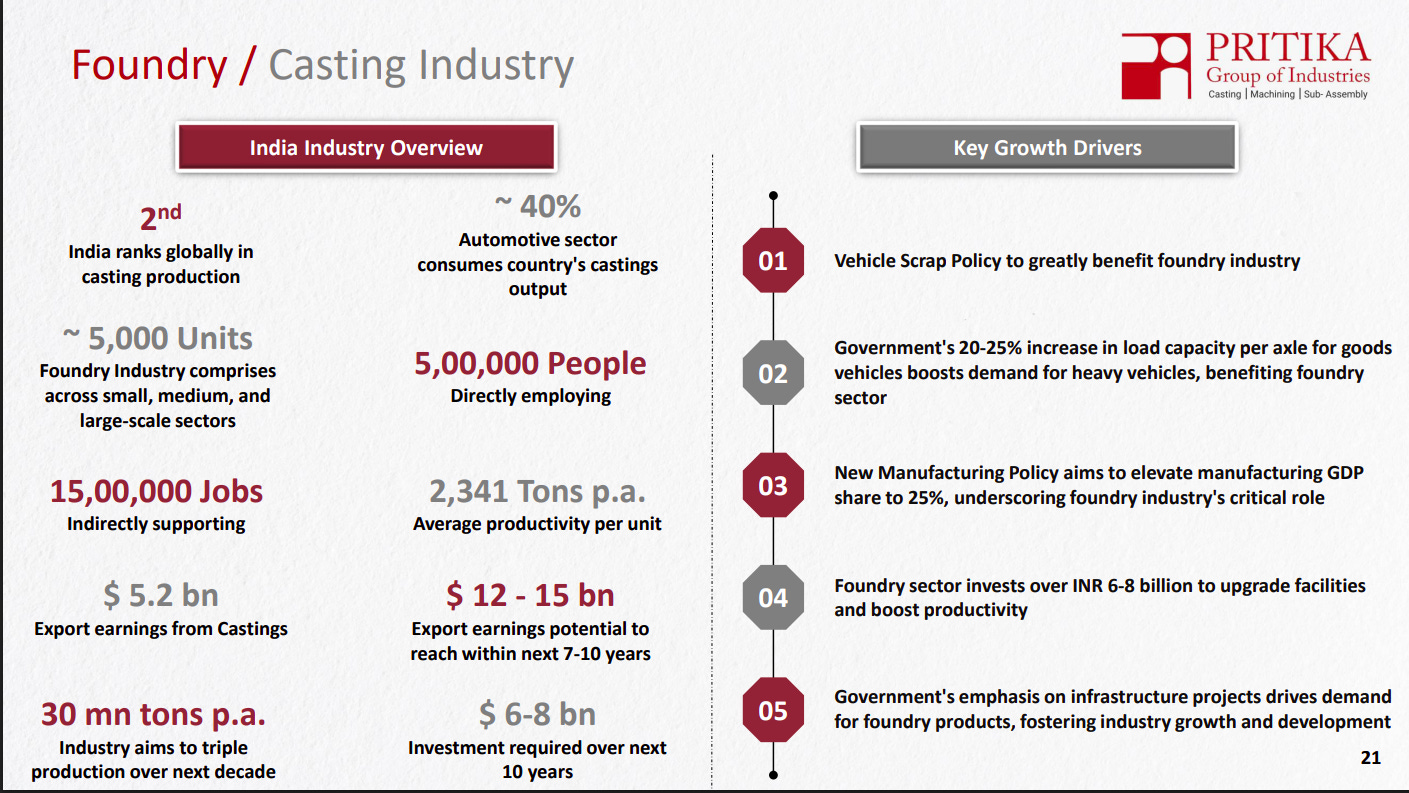
India ranks 2nd globally in casting production, with ~5,000 units and direct employment of 5 lakh people, while the auto sector consumes ~40% of output. Key growth drivers include the vehicle scrappage policy, higher axle load norms, manufacturing policy reforms, infrastructure spending, and planned investments of USD 6–8 bn to enhance productivity and capacity.
Prostarm Info Systems | Micro Cap | Engineering & Capital Goods
Prostarm Info Systems is a company in India that designs, manufactures, assembles, sells, services, and supplies Energy Storage Equipment and Power Conditioning Equipment. Their product range includes UPS systems, inverter systems, solar hybrid inverter systems, lithium-ion battery packs, SCVS, isolation transformers, and other power solution products.
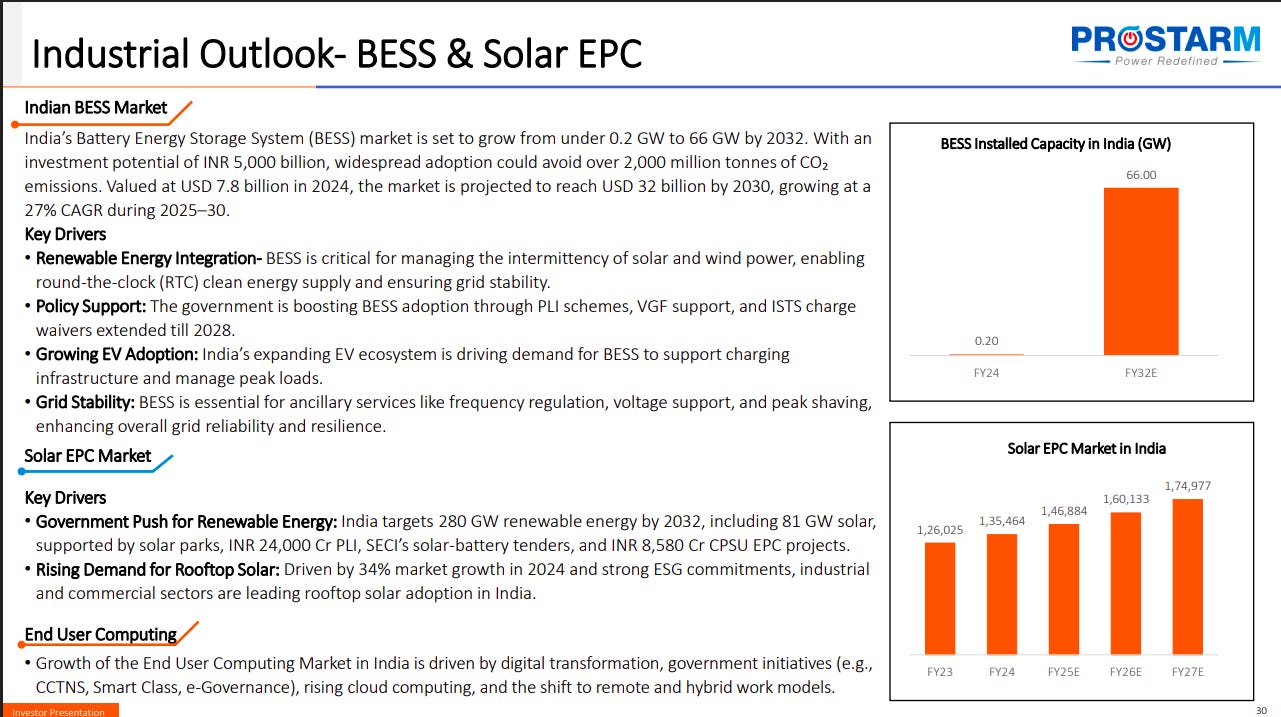
India’s BESS market is set for explosive growth, scaling from ~0.2 GW to 66 GW by 2032, driven by renewable integration, policy support, EV adoption, and grid stability needs. Solar EPC demand remains strong, supported by India’s 280 GW renewable target, rooftop solar expansion, and sustained government capex.
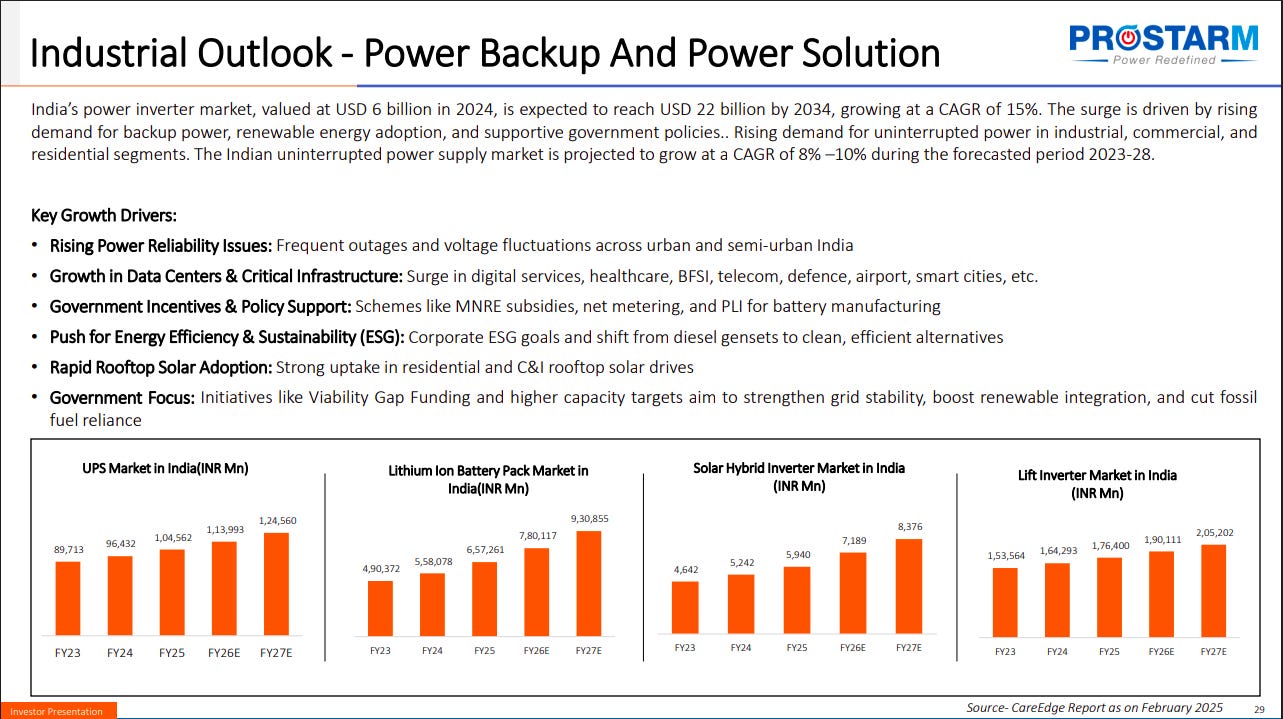
India’s inverter and backup power market is expected to grow steadily, fueled by rising power reliability concerns, data center expansion, and ESG-driven energy shifts. Strong growth is visible across UPS, lithium-ion battery packs, solar hybrid inverters, and lift inverter segments through FY27E.
Quadrant Future Tek | Micro Cap | Engineering & Capital Goods
Quadrant Future Tek is a research-oriented company working on the development of advanced Train Control and Signalling Systems for the Indian Railways’ KAVACH project. They also operate a specialized cable manufacturing facility with an Electron Beam Irradiation Centre, focusing on safety and reliability for rail passengers.
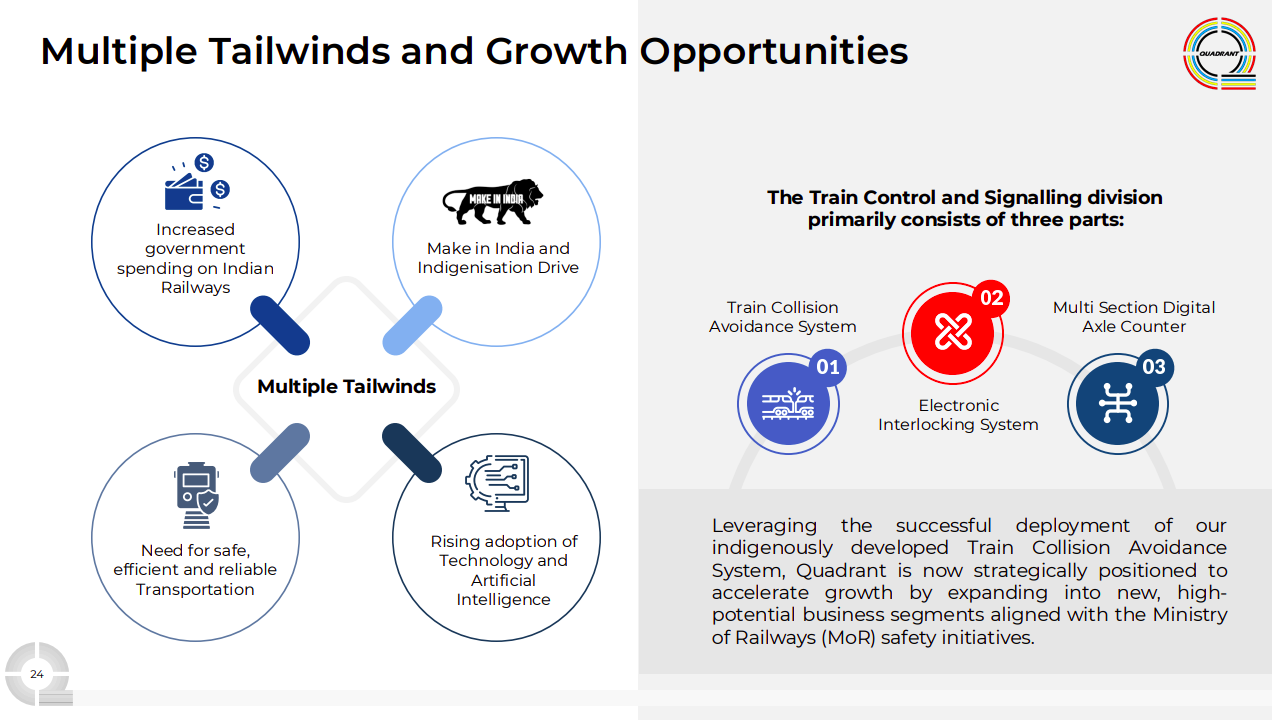
Quadrant is positioned to benefit from rising government spending on Indian Railways, Make-in-India initiatives, increasing focus on transportation safety, and adoption of advanced technologies like AI.
Its Train Control & Signalling division focuses on three core offerings: TCAS (KAVACH), Electronic Interlocking Systems, and Multi-Section Digital Axle Counters.
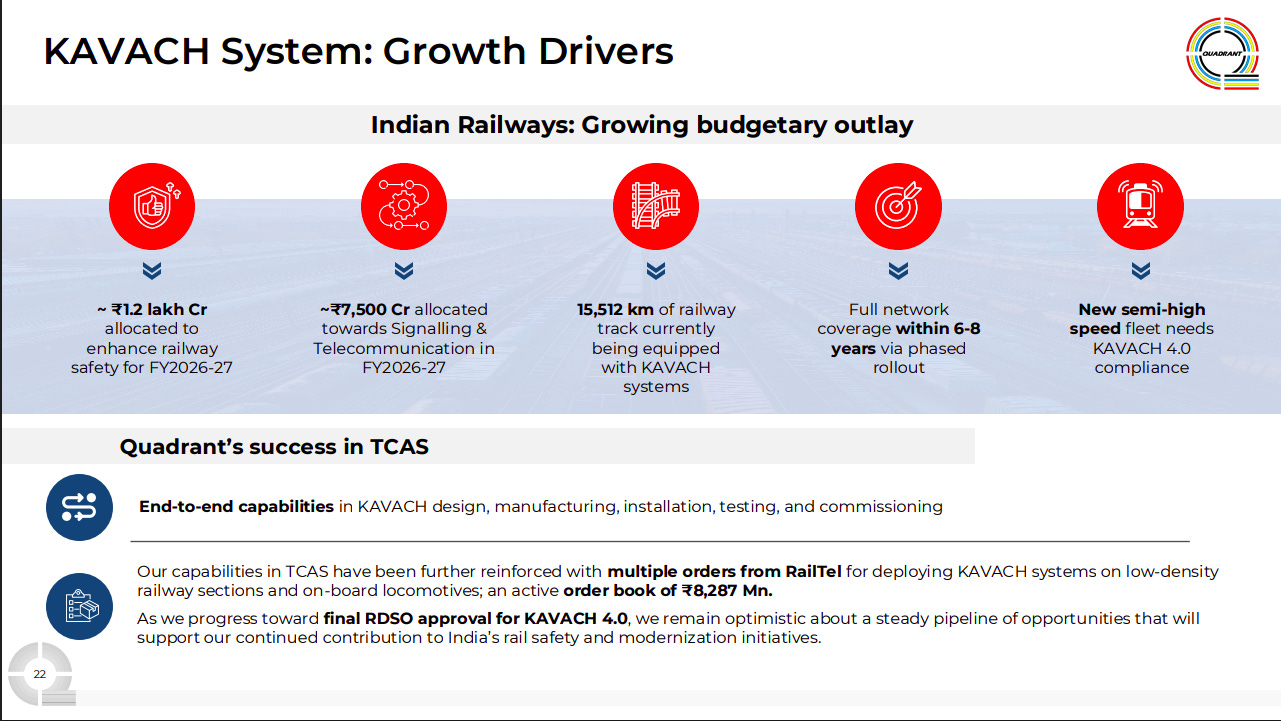
Indian Railways’ expanding safety budget and ₹7,500 Cr allocation for signalling & telecom are driving strong demand for KAVACH systems. With 15,512 km already equipped and full network coverage planned within 6–8 years, Quadrant is supported by a healthy ₹8,287 Mn order book and progressing toward KAVACH 4.0 approval.
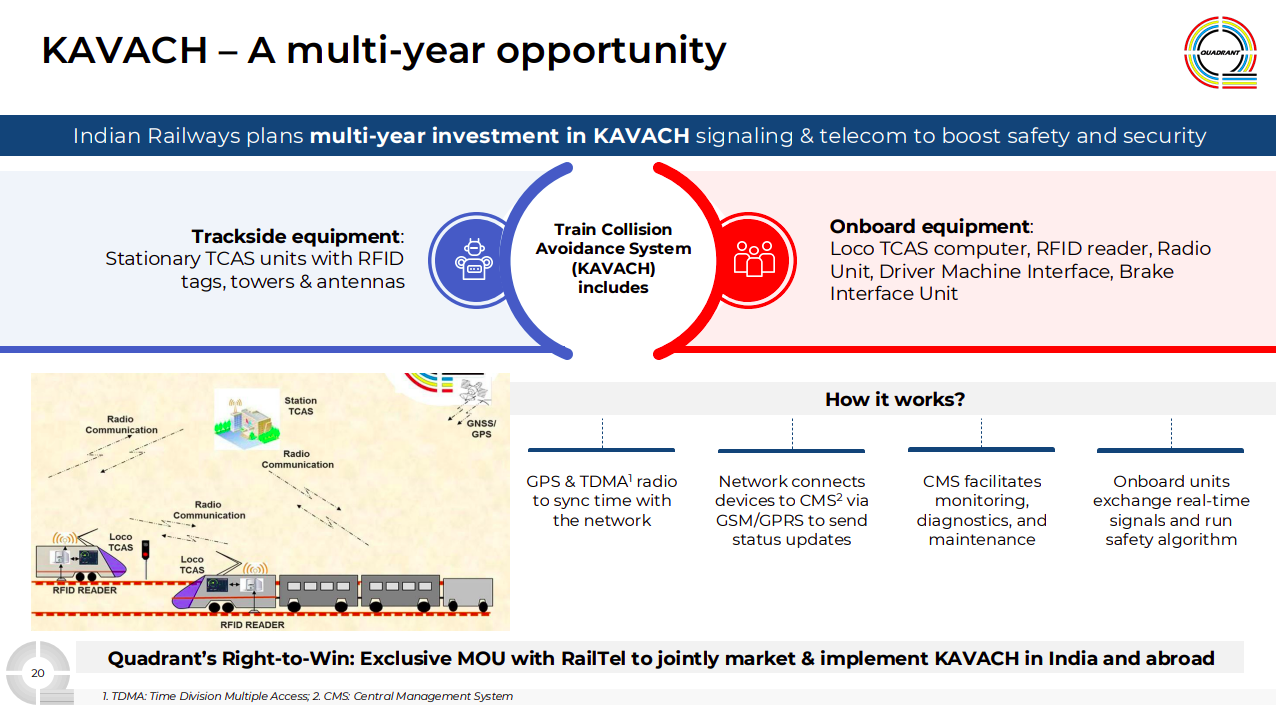
KAVACH integrates trackside infrastructure (RFID tags, antennas, stationary TCAS units) with onboard systems to enable real-time train safety monitoring.
Quadrant’s exclusive MOU with RailTel strengthens its right-to-win in both domestic and international markets for this long-term railway modernization opportunity.
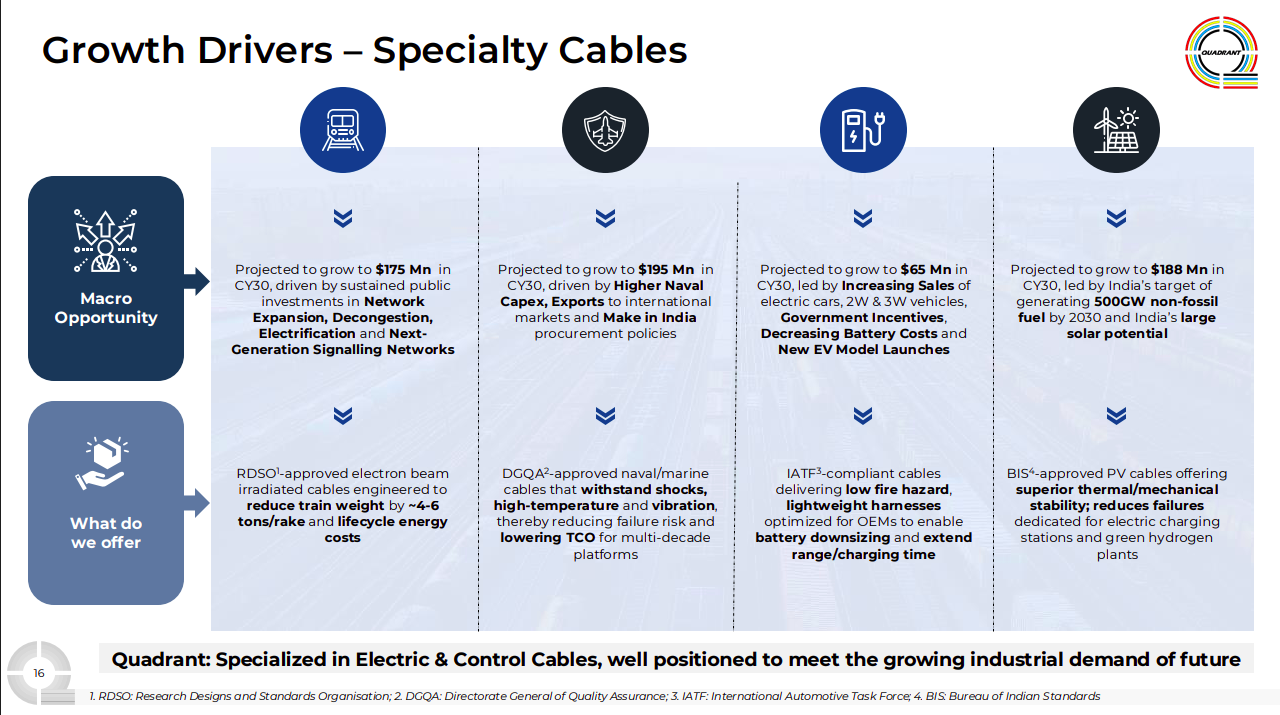
Specialty cable demand is projected to grow across railways, defence, EVs, and renewables, driven by electrification, indigenization, and higher capex.
Quadrant offers advanced, certified cables (RDSO, DGQA, IATF, BIS) that enhance durability, reduce lifecycle costs, and support next-gen mobility and energy solutions.
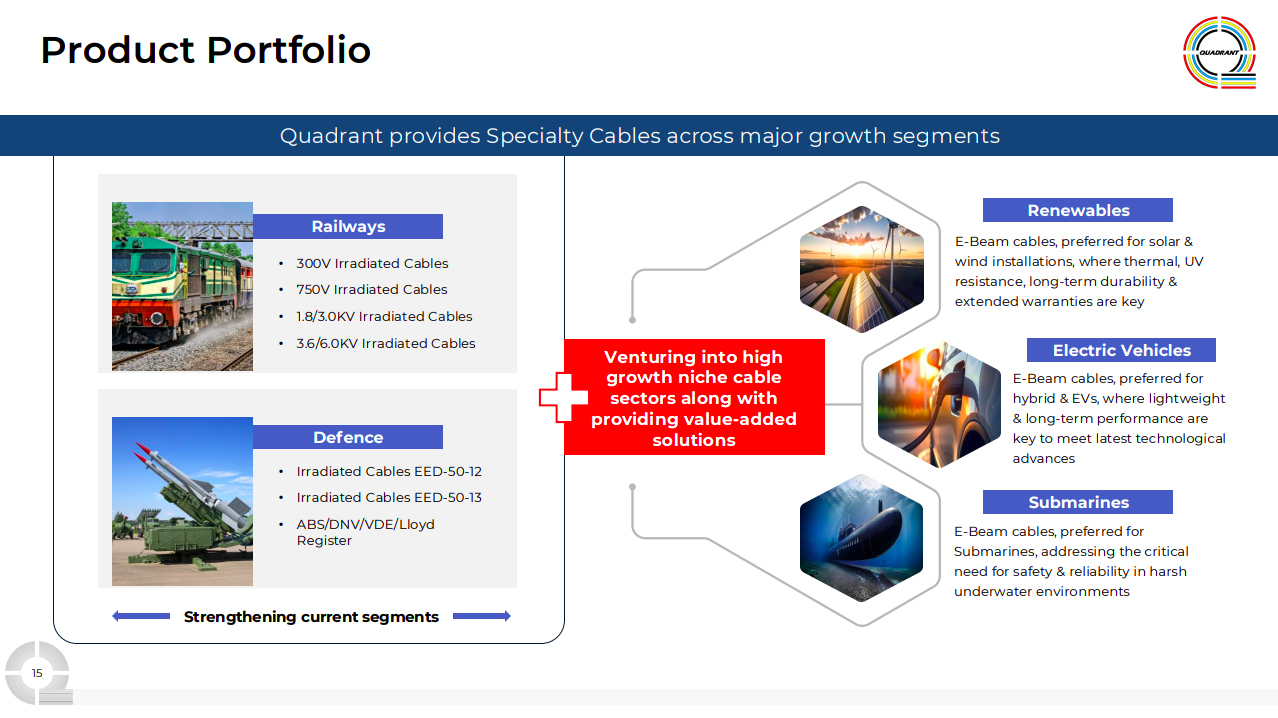
Quadrant serves core segments like Railways and Defence while expanding into high-growth niches such as Renewables, EVs, and Submarines.
Its strategy combines strengthening legacy segments with venturing into value-added, technology-intensive cable applications.
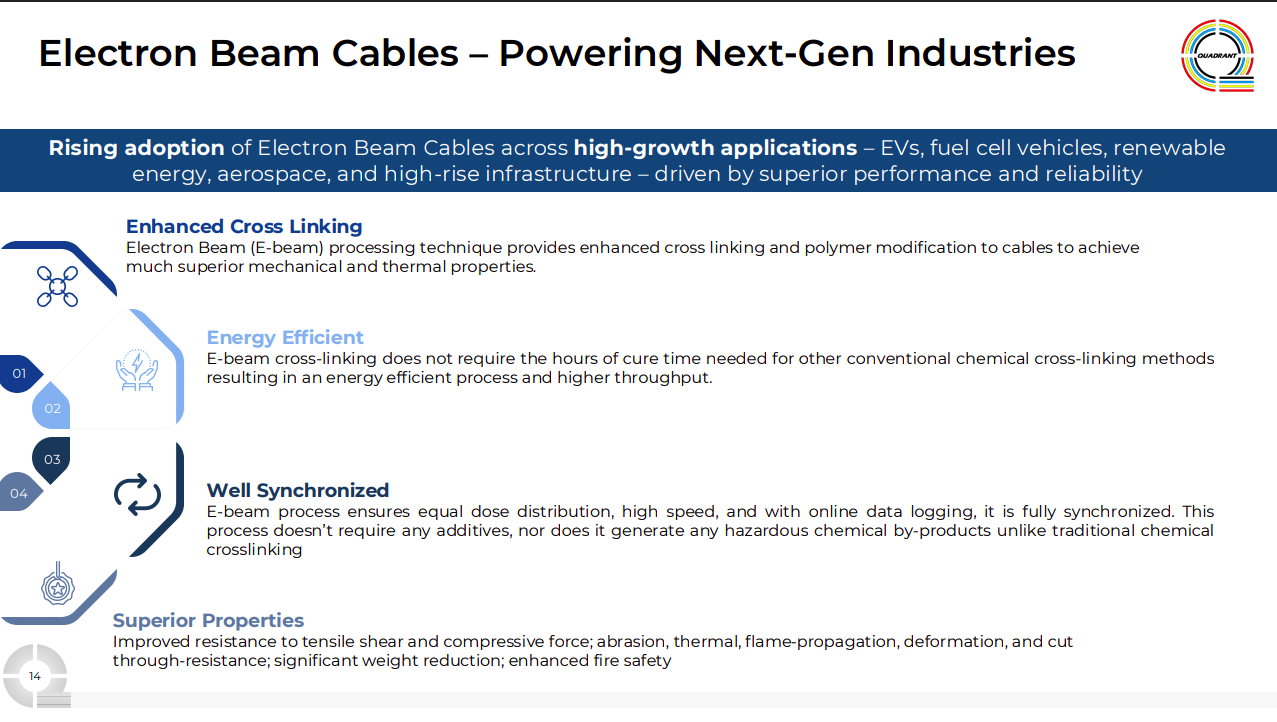
Electron Beam (E-beam) technology enhances cable strength, thermal resistance, fire safety, and overall performance without chemical cross-linking.
The process is energy-efficient, synchronized, and ideal for high-growth sectors like EVs, renewables, aerospace, and infrastructure.
SPML Infra | Small Cap | Engineering & Capital Goods
SPML Infra Limited is a leading infrastructure development company in India, focusing on sustainable development for smart cities by providing essential services like water, electricity, sanitation, and waste management. The company specializes in offering end-to-end water and wastewater management solutions, leveraging its expertise in engineering, process technology, project management, and construction. SPML Infra has a track record of setting new benchmarks in modern construction and time management for its projects.
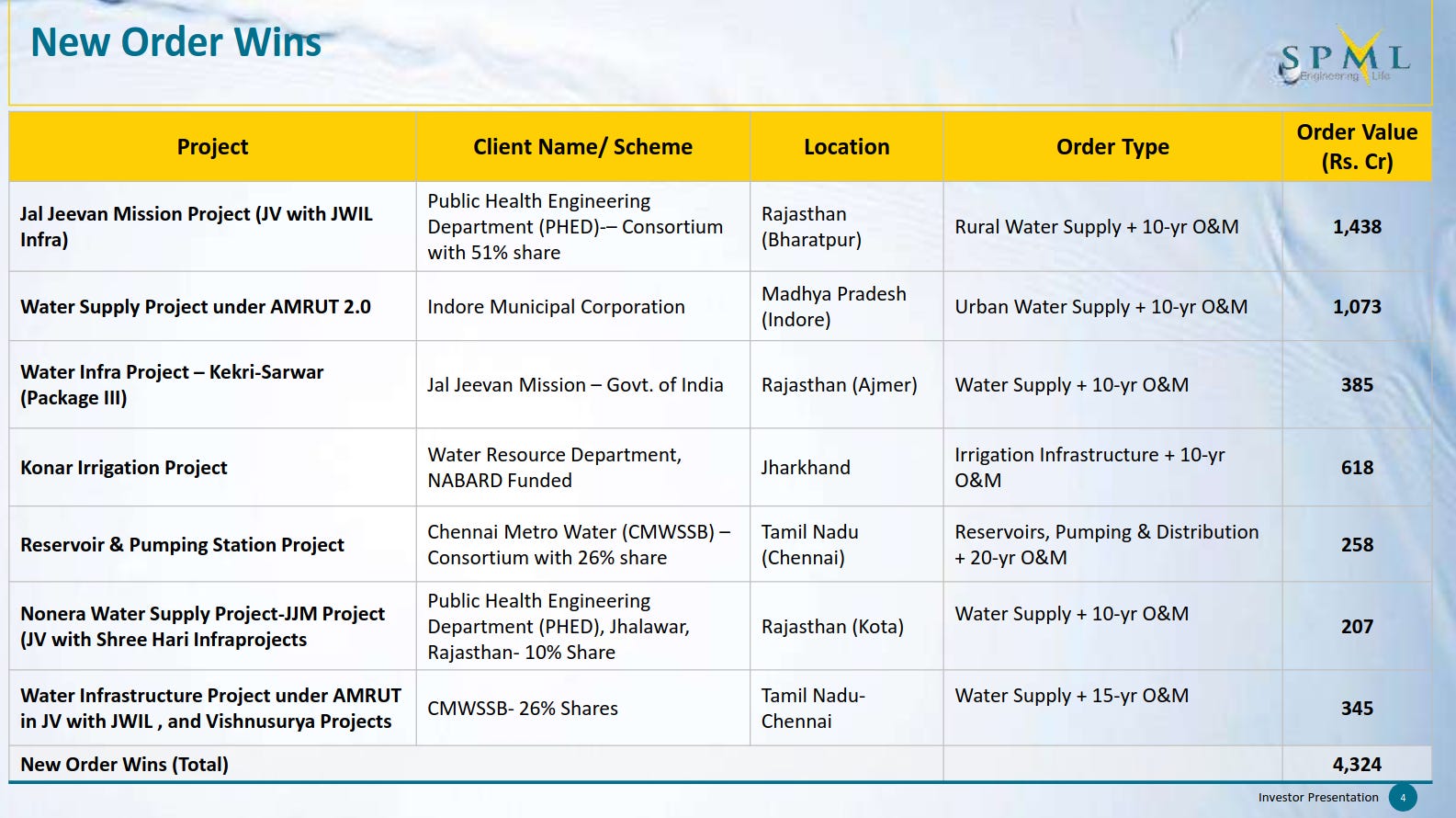
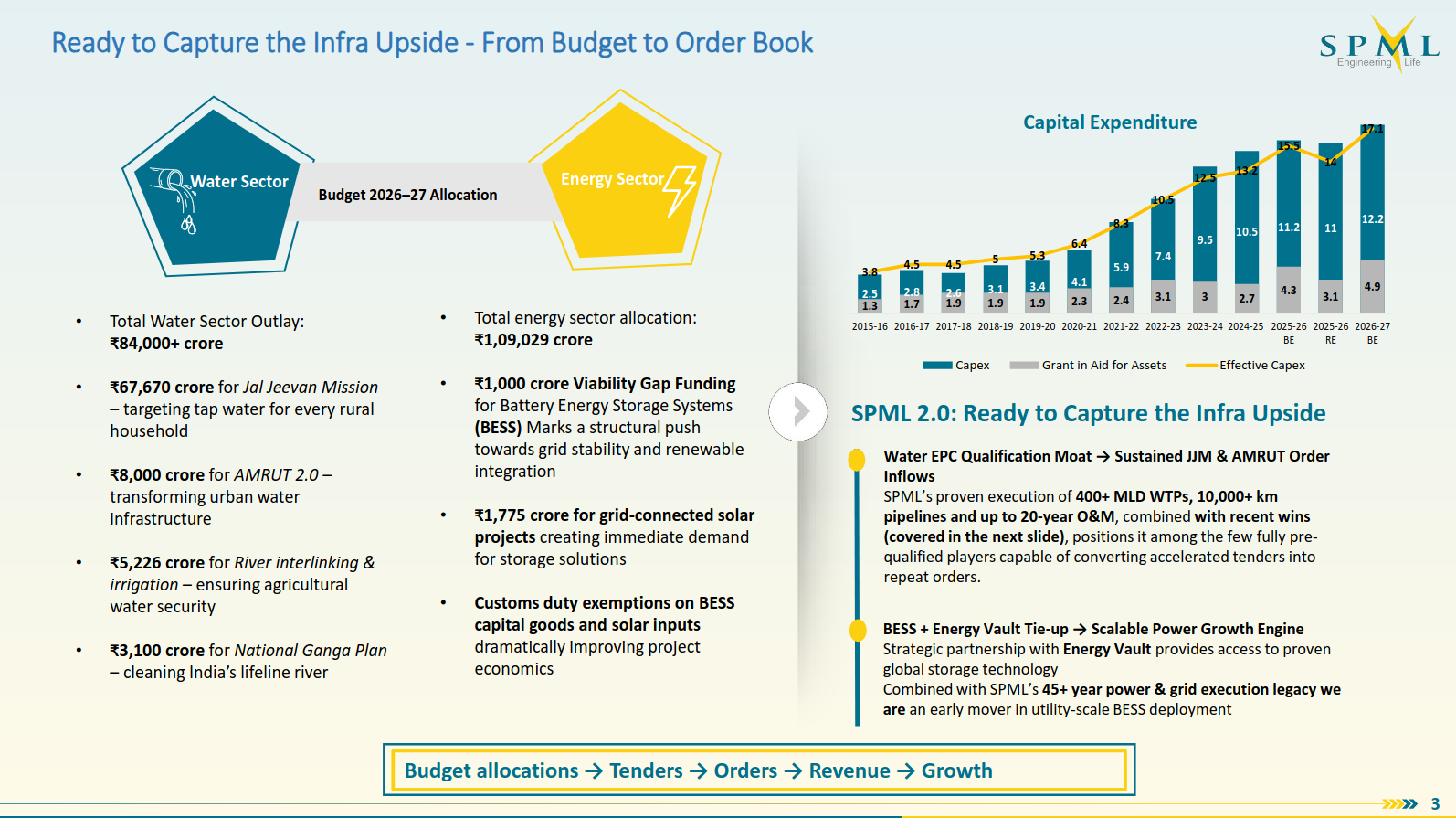
SPML secured new orders worth ₹4,324 crore across water supply and irrigation projects, largely under Jal Jeevan Mission and AMRUT 2.0.
Major wins include large rural and urban water supply contracts in Rajasthan, Madhya Pradesh, Tamil Nadu, and Jharkhand, typically bundled with long-term O&M (10–20 years), strengthening revenue visibility.
The Union Budget 2026–27 allocations for water (₹84,000+ crore) and energy (₹1.09 lakh crore) create a strong demand pipeline across JJM, AMRUT, irrigation, solar, and BESS.
SPML aims to leverage its EPC track record and BESS partnership to convert budgetary outlays into tenders, orders, and long-term revenue growth, supported by rising capex trends.
Shakti Pumps | Small Cap | Engineering & Capital Goods
Shakti Pumps (India) Limited, established in 1982, focuses on producing energy-efficient pumps and motors. Their extensive product range, developed in-house, caters to various sectors including agriculture, industrial applications, and water supply schemes. With a commitment to innovation, they aim to meet India’s irrigation and pumping needs with technologically advanced solutions.
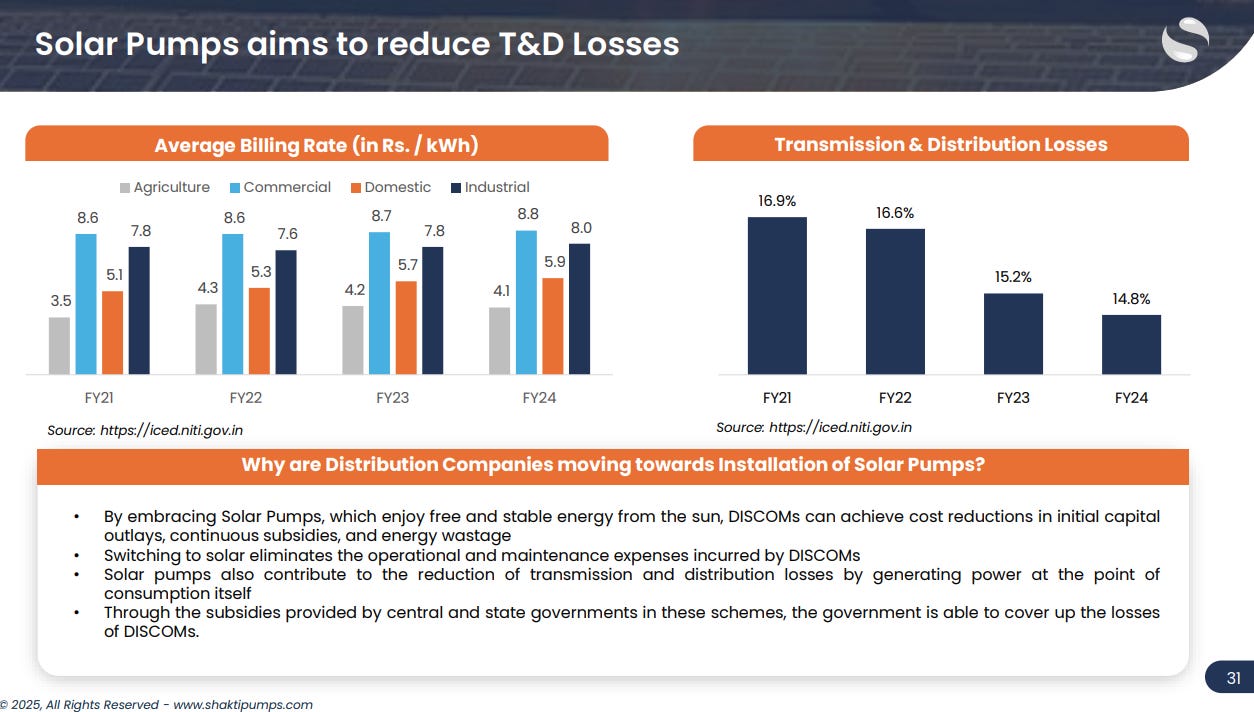
Electricity distribution companies are pushing for solar pumps to reduce transmission and distribution losses, which have fallen from 16.9% in FY21 to 14.8% in FY24. Average billing rates have been rising across all consumer categories, with agriculture at Rs. 4.1 per kWh, commercial at Rs. 8.8 per kWh, domestic at Rs. 5.9 per kWh, and industrial at Rs. 8.0 per kWh in FY24. Solar pumps offer a win-win as they cut capital outlays, ongoing subsidies, and energy wastage for distribution companies, while generating power at the point of use and eliminating maintenance costs. The government is able to cover distribution company losses through subsidies in these solar schemes, making the transition economically viable.
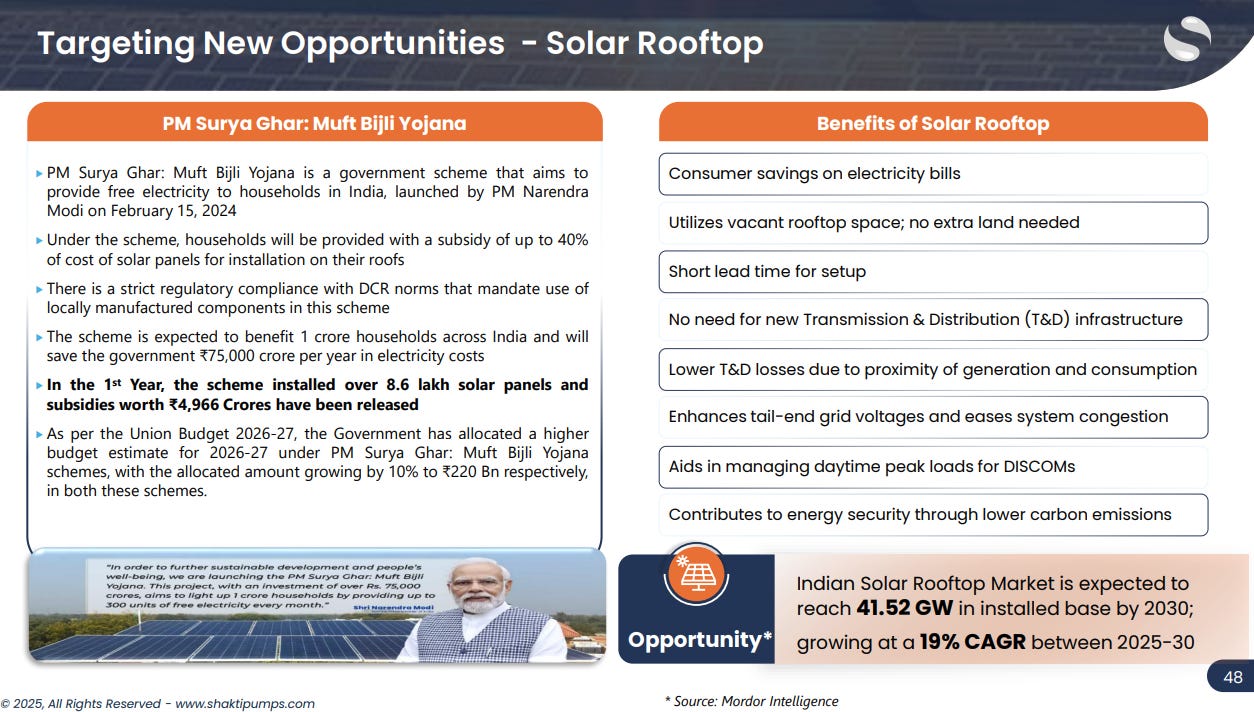
The PM Surya Ghar Muft Bijli Yojana launched in February 2024 offers households a subsidy of up to 40% for installing solar panels on their roofs. In its first year, the scheme installed over 8.6 lakh solar panels and released subsidies worth Rs. 4,966 crores, with the budget allocation increasing by 10% to Rs. 220 billion for 2026-27. Solar rooftops bring multiple benefits including savings on electricity bills, no need for extra land or transmission infrastructure, lower distribution losses, and better grid management during peak hours. The Indian solar rooftop market is expected to reach 41.52 GW by 2030, growing at 19% annually between 2025-30, presenting a significant opportunity for companies in this space.
Textiles
Indian Terrain Fashions | Nano Cap | Textiles
Indian Terrain Fashions Ltd (ITFL) is a leading ready-made garment retailer in India, offering men’s wear, boys wear, and fashion accessories through various sales channels. Established in 2009 as a division of Celebrity Fashions Limited, ITFL became independent in September 2010. The company’s product range includes shirts, trousers, t-shirts, jeanswear, shorts, sweaters, belts, bags, wallets, and socks, distributed through Direct to Consumer and Wholesale channels across multiple Indian towns and cities.
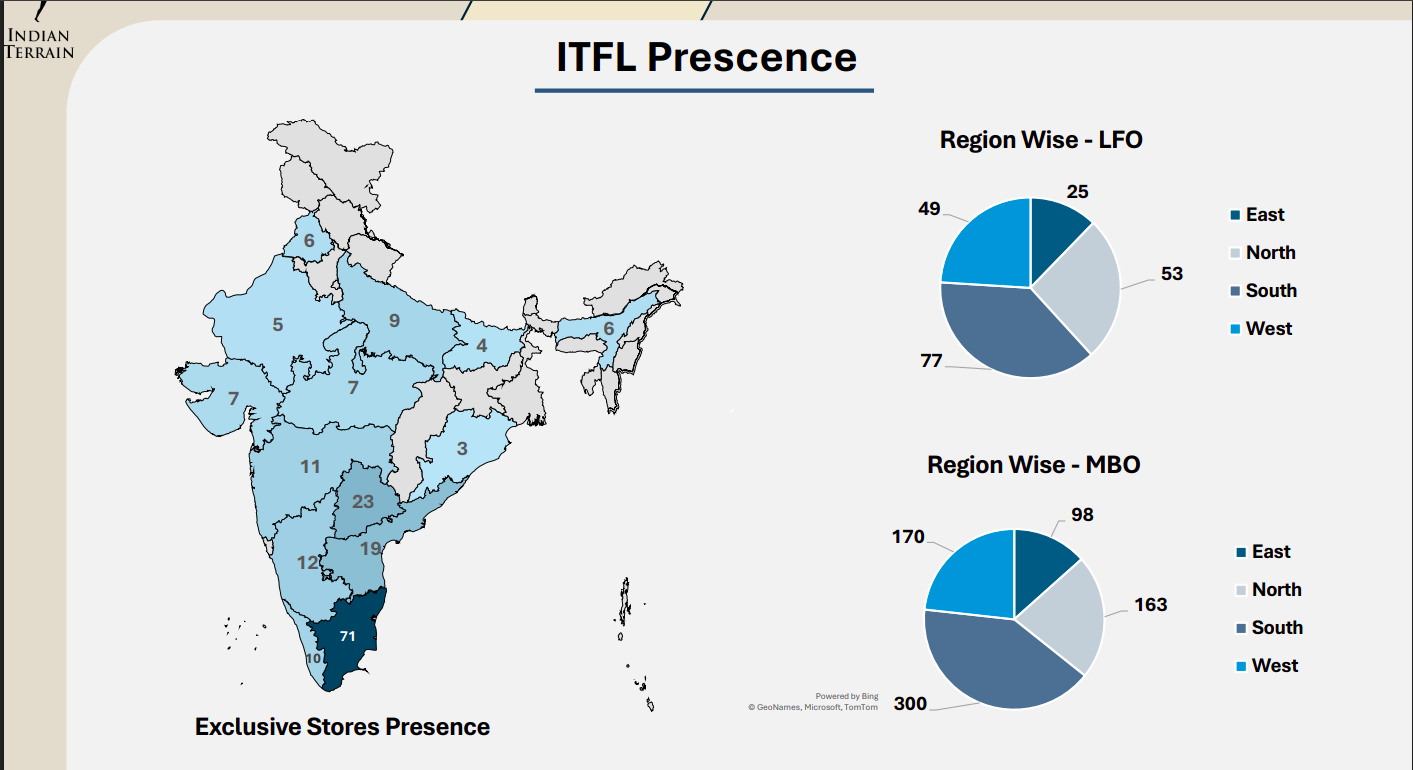
ITFL has a strong pan-India footprint with a higher concentration of exclusive stores in South and West India. Region-wise, South leads both LFO and MBO formats, followed by North and West, while East has a relatively smaller presence.
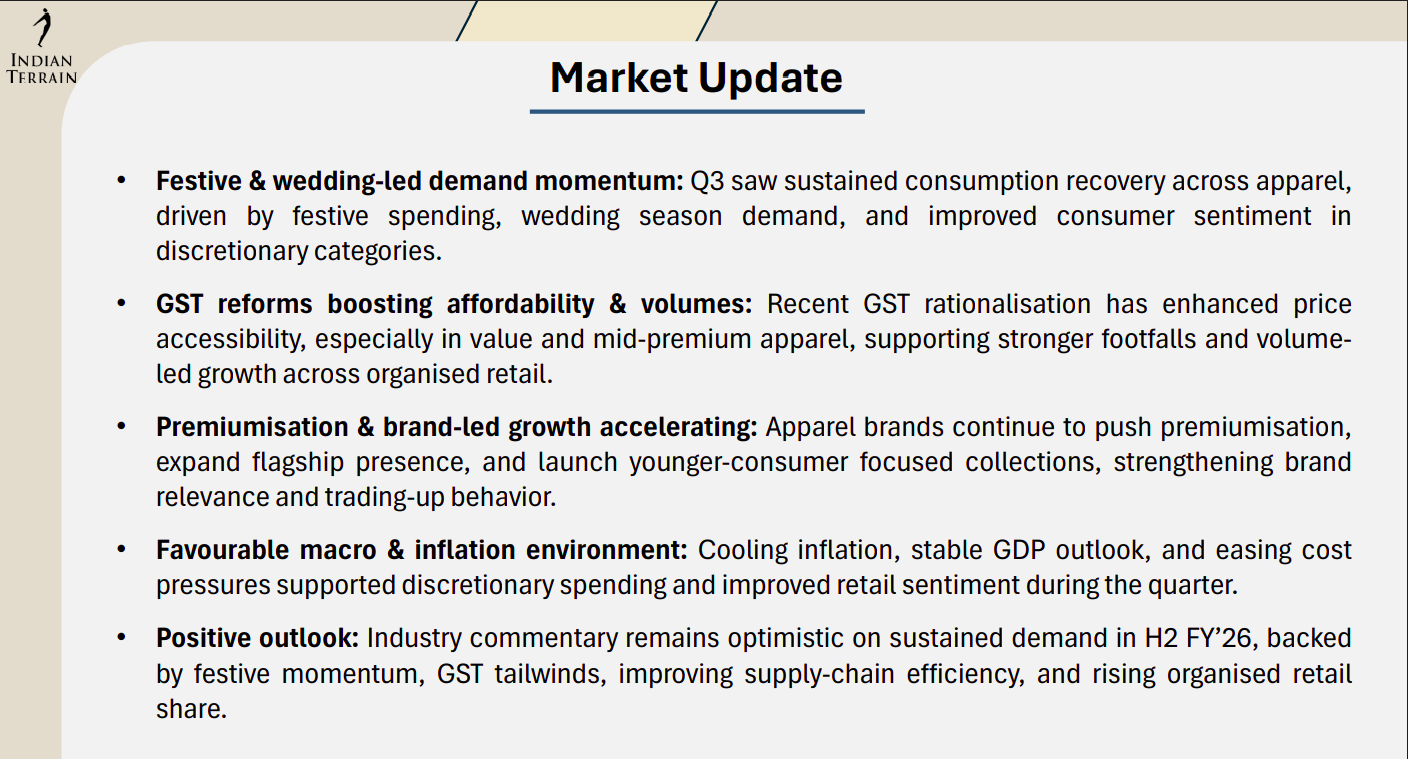
Q3 witnessed demand recovery driven by festive and wedding-led spending, along with improved consumer sentiment. GST rationalisation, premiumisation trends, and a stable macro environment supported higher footfalls, with a positive outlook for H2 FY26 backed by organised retail growth and supply-chain efficiencies.
Metals
MMP Industries | Micro Cap | Metals
MMP Industries, formerly known as Maharashtra Metal Powders, specializes in producing Aluminium powders and pastes for global distribution. They have invested significantly in research and offer a wide range of products targeting the Construction Industry. With exports to Europe, Middle-East, Africa, and the Asia Pacific regions, MMP Industries is a pioneer in providing Aluminium powder solutions tailored to customer needs.
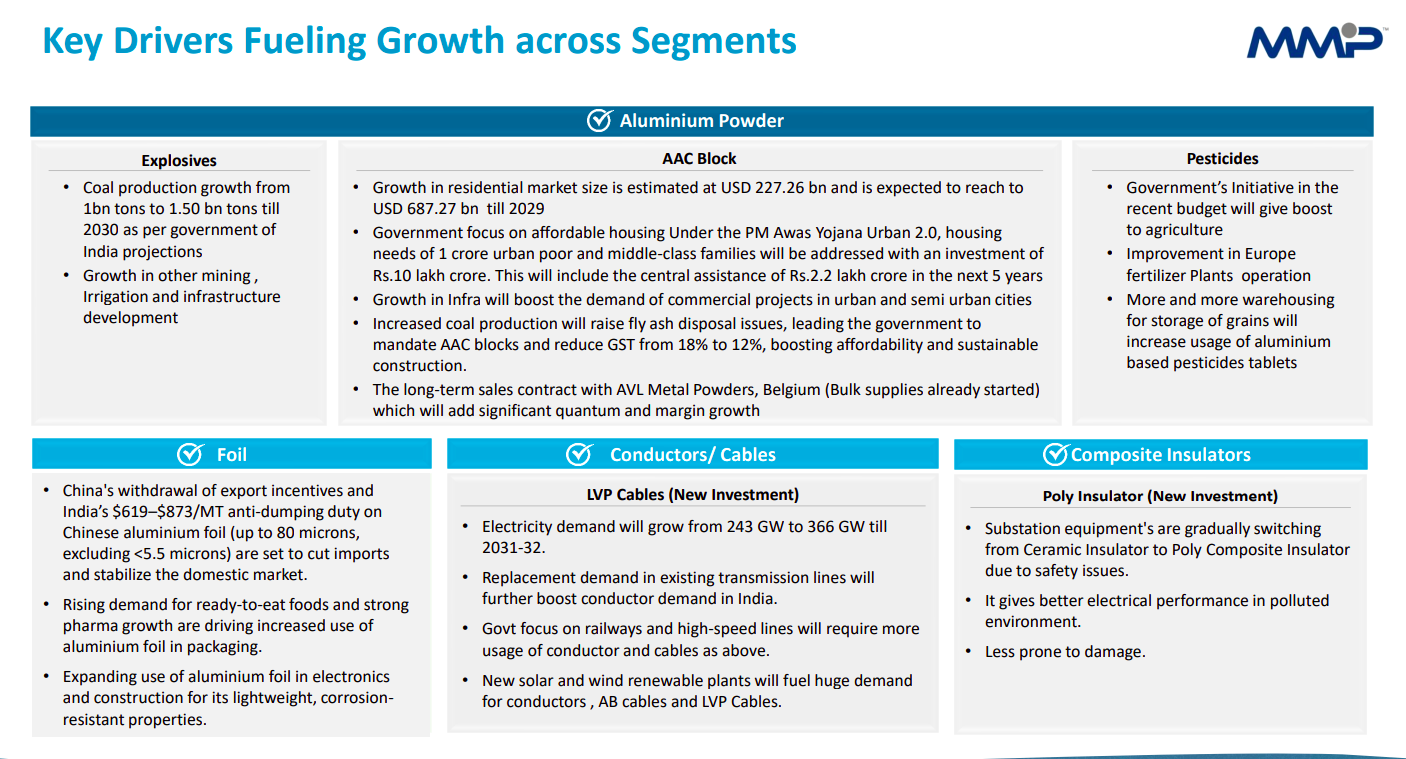
The slide outlines demand triggers across explosives, AAC blocks, pesticides, foil, conductors/cables, and composite insulators. Infrastructure push, affordable housing, renewable energy, anti-dumping measures, and power transmission investments are expected to drive sustained volume and margin growth across aluminium-based applications.
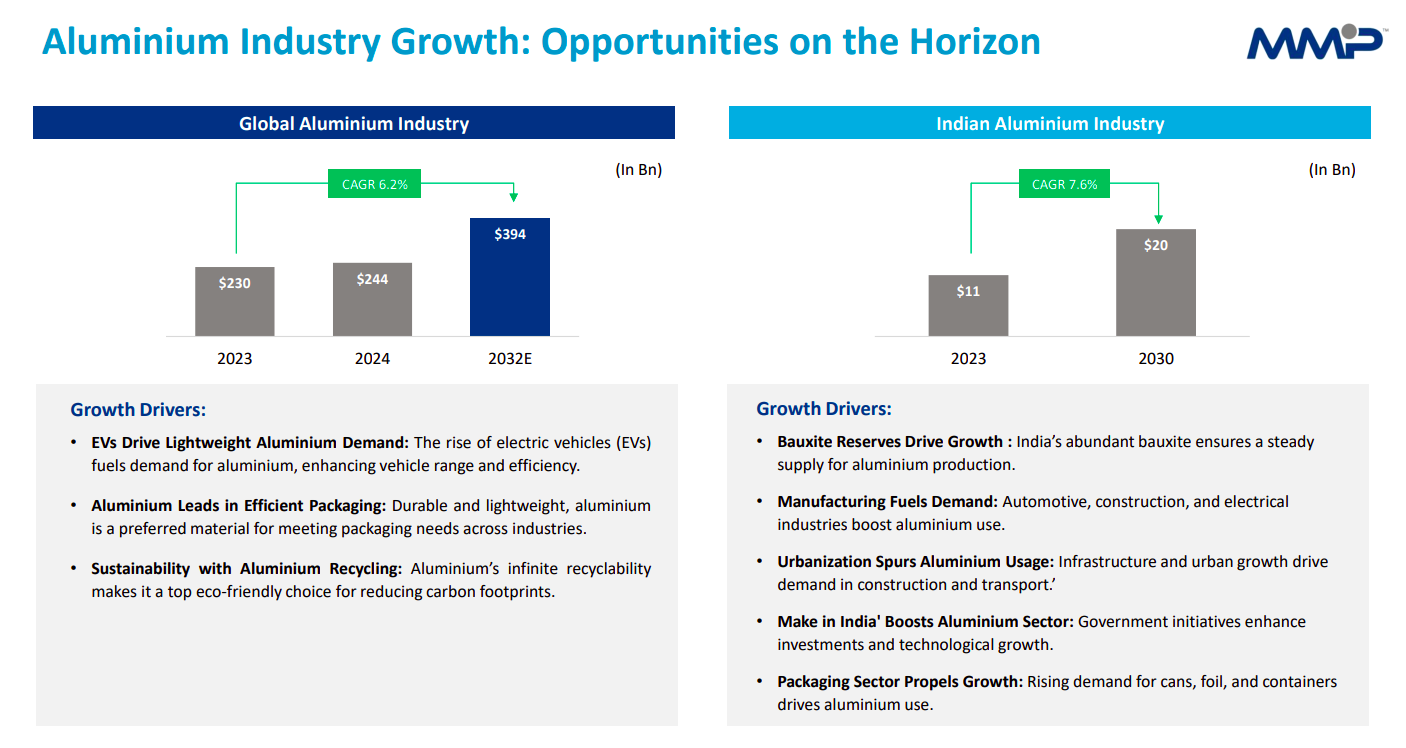
The global aluminium market is projected to grow at ~6.2% CAGR to ~$394 bn by 2032E, while India is expected to grow faster at ~7.6% CAGR to ~$20 bn by 2030. Key drivers include EV-led lightweighting, urbanisation, manufacturing growth, packaging demand, and strong bauxite reserves supporting domestic production.
Media & Entertainment
Dachepalli Publishers | Nano Cap | Media & Entertainment
Dachepalli Publishers Ltd. is an educational publishing company specializing in K–12 textbooks and learning materials. The company serves schools across India and focuses on curriculum-aligned print and digital educational resources.
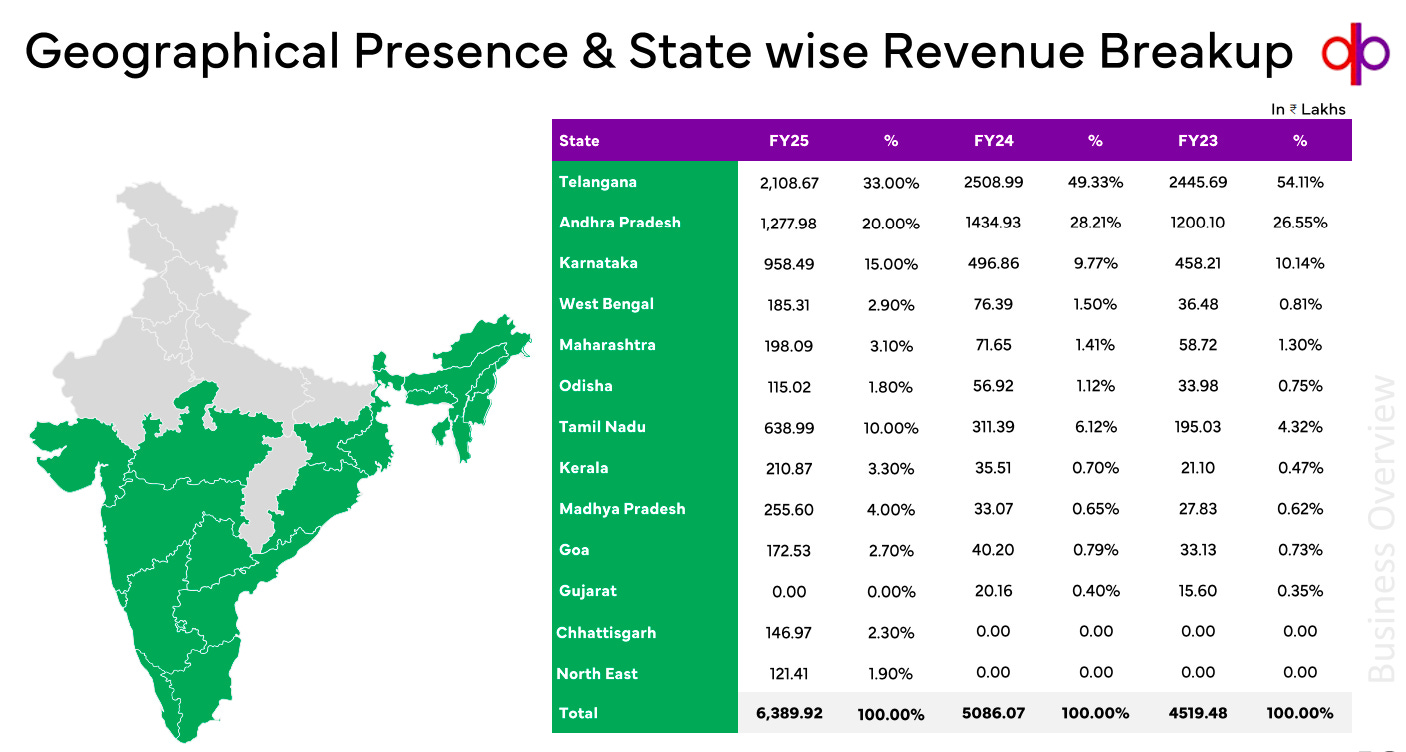
The company derives a majority of its FY25 revenue from Telangana (33%) and Andhra Pradesh (20%), with Karnataka (15%) and Tamil Nadu (10%) as other key contributors. Revenue has diversified compared to FY24–FY23, with rising contributions from Maharashtra, Kerala, MP, and newer regions like Chhattisgarh and North East. Total revenue increased to ₹6,389.9 lakhs in FY25 from ₹5,086.1 lakhs in FY24 and ₹4,519.5 lakhs in FY23.
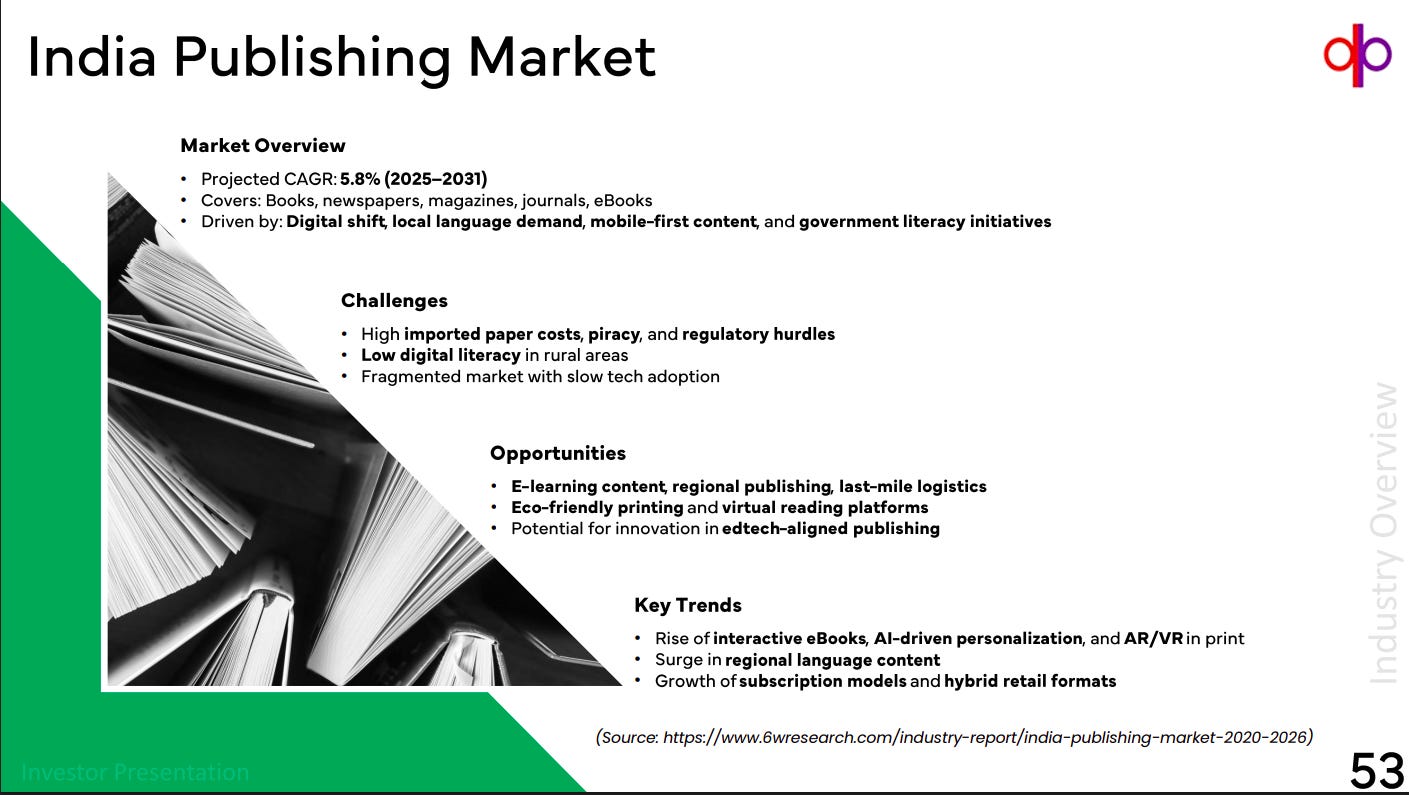
The Indian publishing market is projected to grow at a 5.8% CAGR (2025–2031), driven by digital adoption, regional language demand, and government literacy initiatives. While high paper costs, piracy, and low rural digital literacy remain challenges, opportunities lie in e-learning, edtech-aligned publishing, and subscription-based models. Trends include interactive eBooks, AI-driven personalization, and hybrid retail formats.
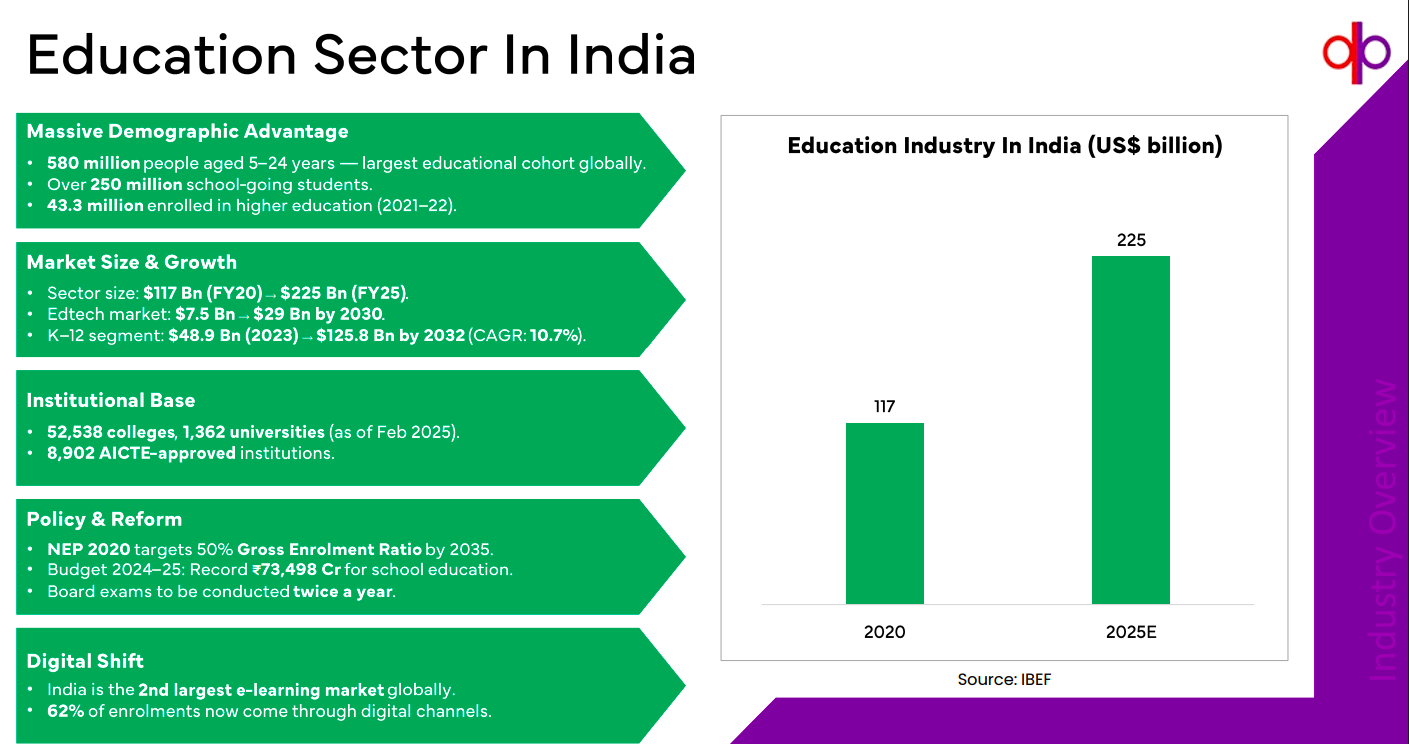
India’s education sector has expanded from $117 billion (FY20) to an estimated $225 billion (FY25E), supported by strong demographics and policy reforms like NEP 2020. The country has over 580 million youth (5–24 years), 52,000+ colleges, and growing digital adoption, with 62% of enrollments through online channels. Edtech and K-12 segments are witnessing strong long-term growth momentum.
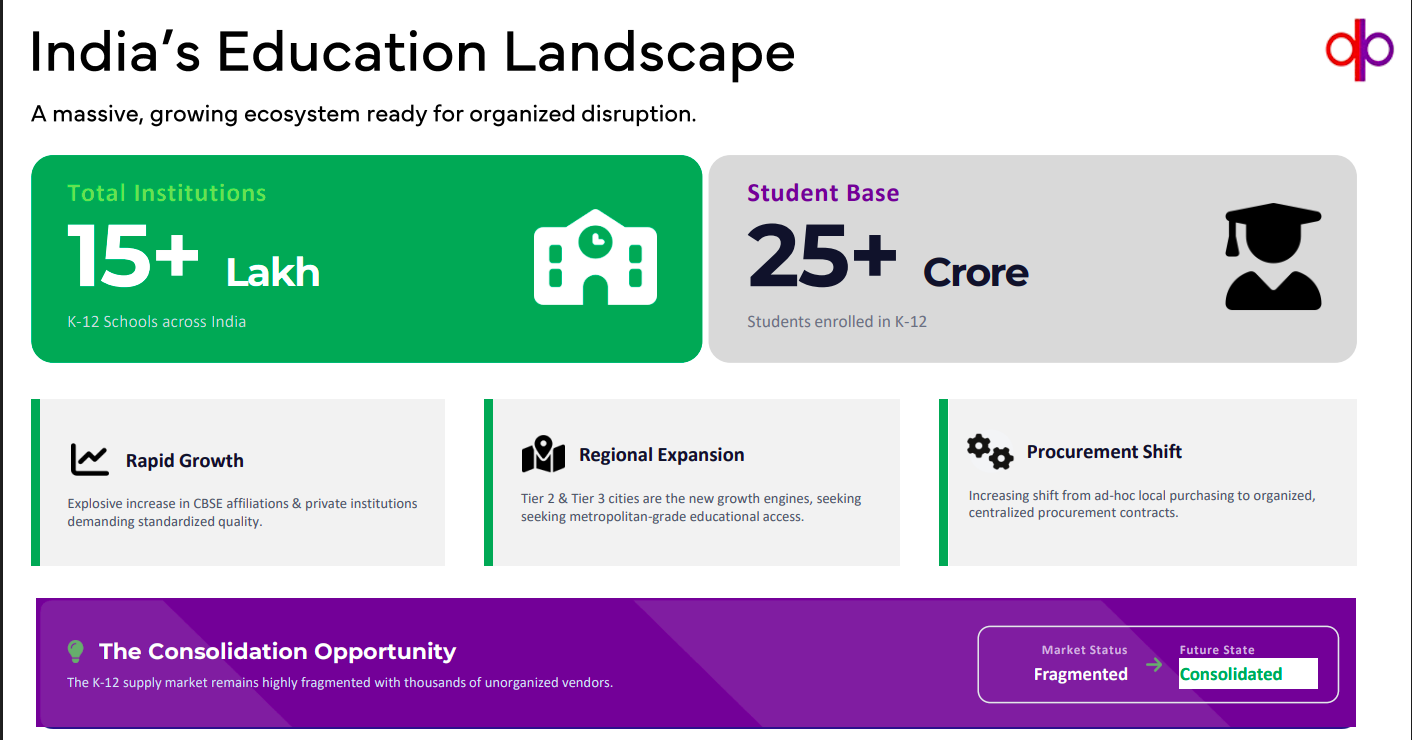
India has 15+ lakh K-12 institutions and a massive 25+ crore student base, creating a large and scalable market opportunity. Growth is being driven by rapid expansion in private and CBSE-affiliated schools, rising demand from Tier 2/3 cities, and a shift toward centralized procurement. The fragmented market structure presents a strong consolidation opportunity for organized players.
Auto Ancillary
Tenneco Clean Air India | Small Cap | Auto Ancillary
Tenneco Clean Air India Ltd. (TCAIL), founded in 1979 and part of U.S.-based Tenneco Group, designs and manufactures clean air, powertrain, and suspension solutions for Indian and global OEMs. It leads in CT, OH, and PV segments and exports across major global markets.
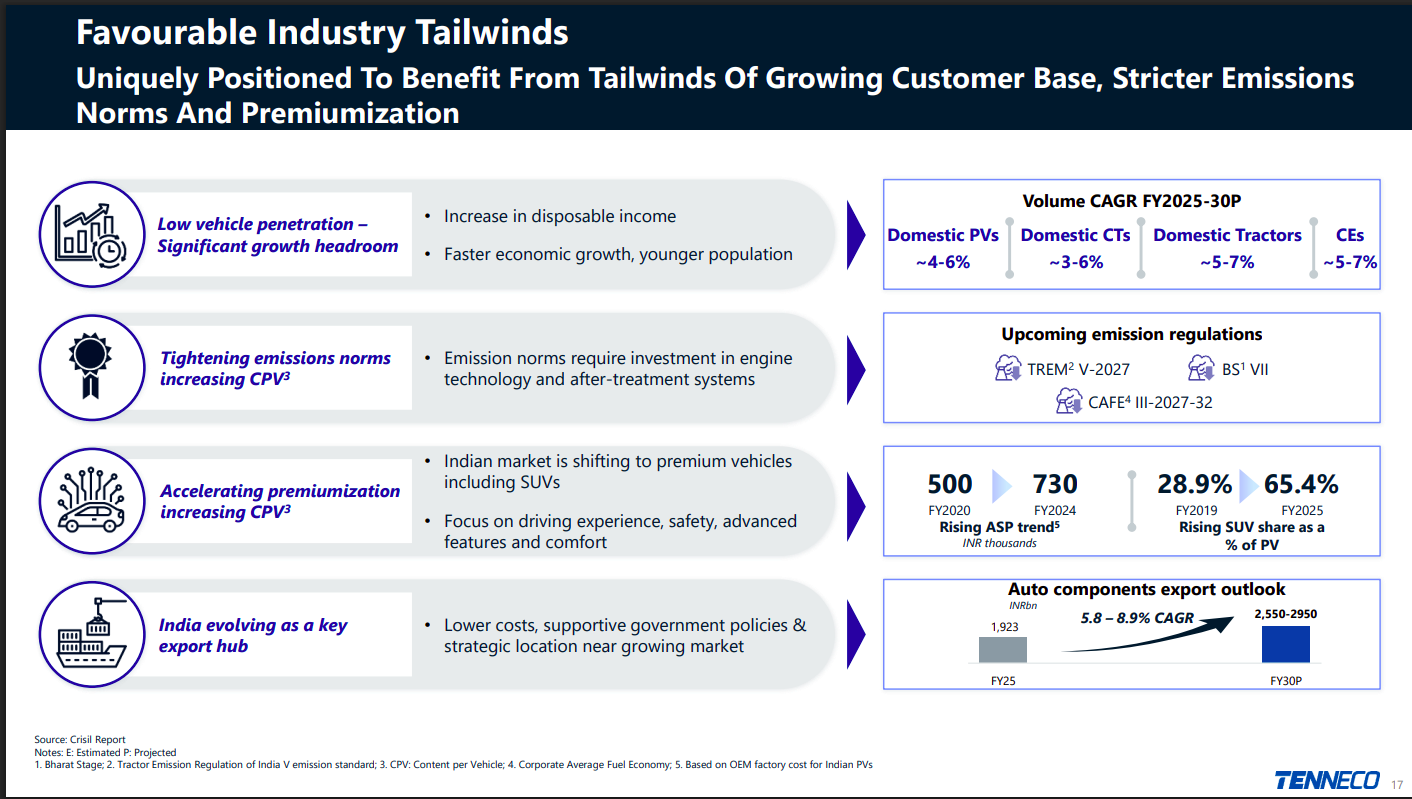
Low vehicle penetration, rising disposable income, tightening emission norms, and premiumisation are creating strong multi-year growth tailwinds for the auto components sector. Domestic PVs, tractors, and CEs are expected to grow at healthy CAGRs, while exports are projected to expand 5.8–8.9% through FY30.
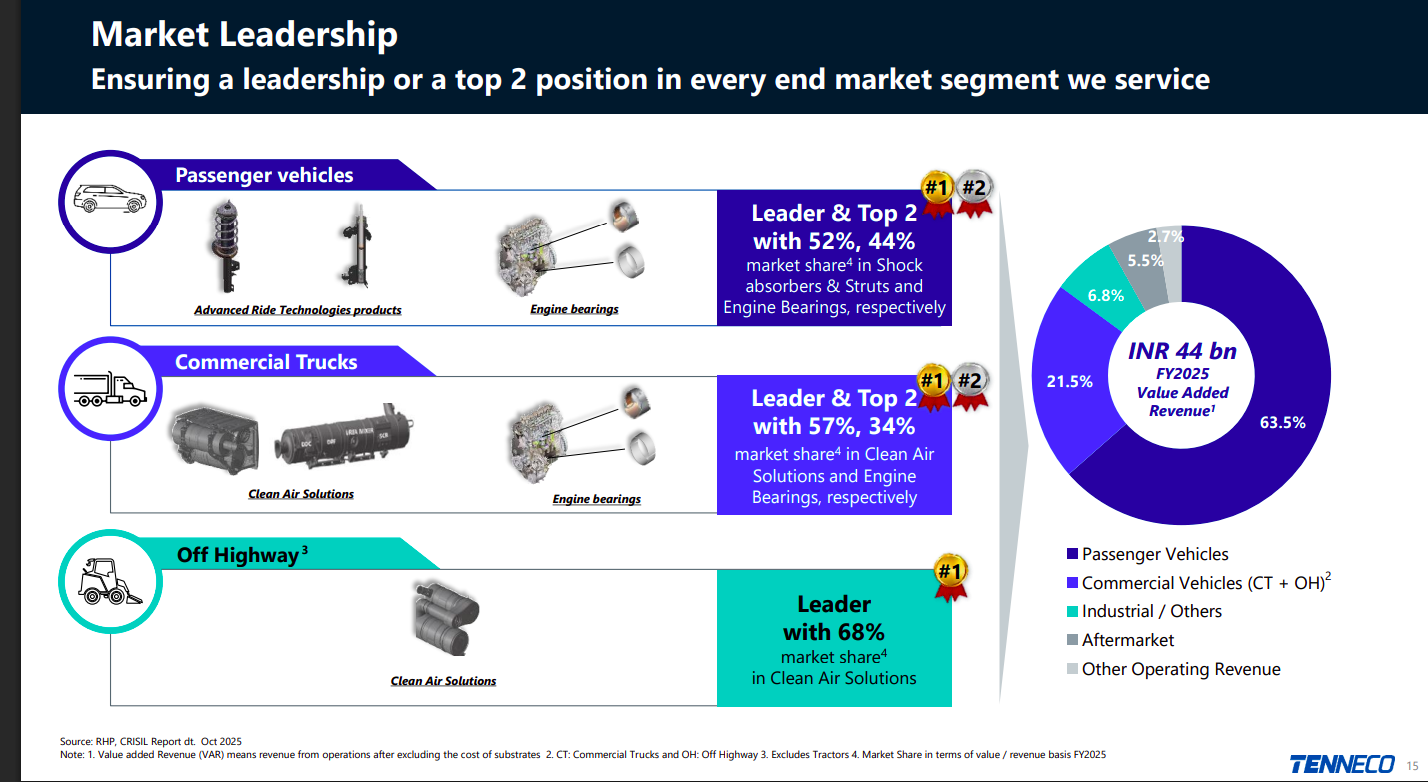
Tenneco holds leadership or top-two positions across key segments—passenger vehicles, commercial trucks, and off-highway—with dominant market shares in clean air solutions and engine bearings. FY25 value-added revenue stands at ₹44 bn, largely driven by passenger vehicles (63.5%).
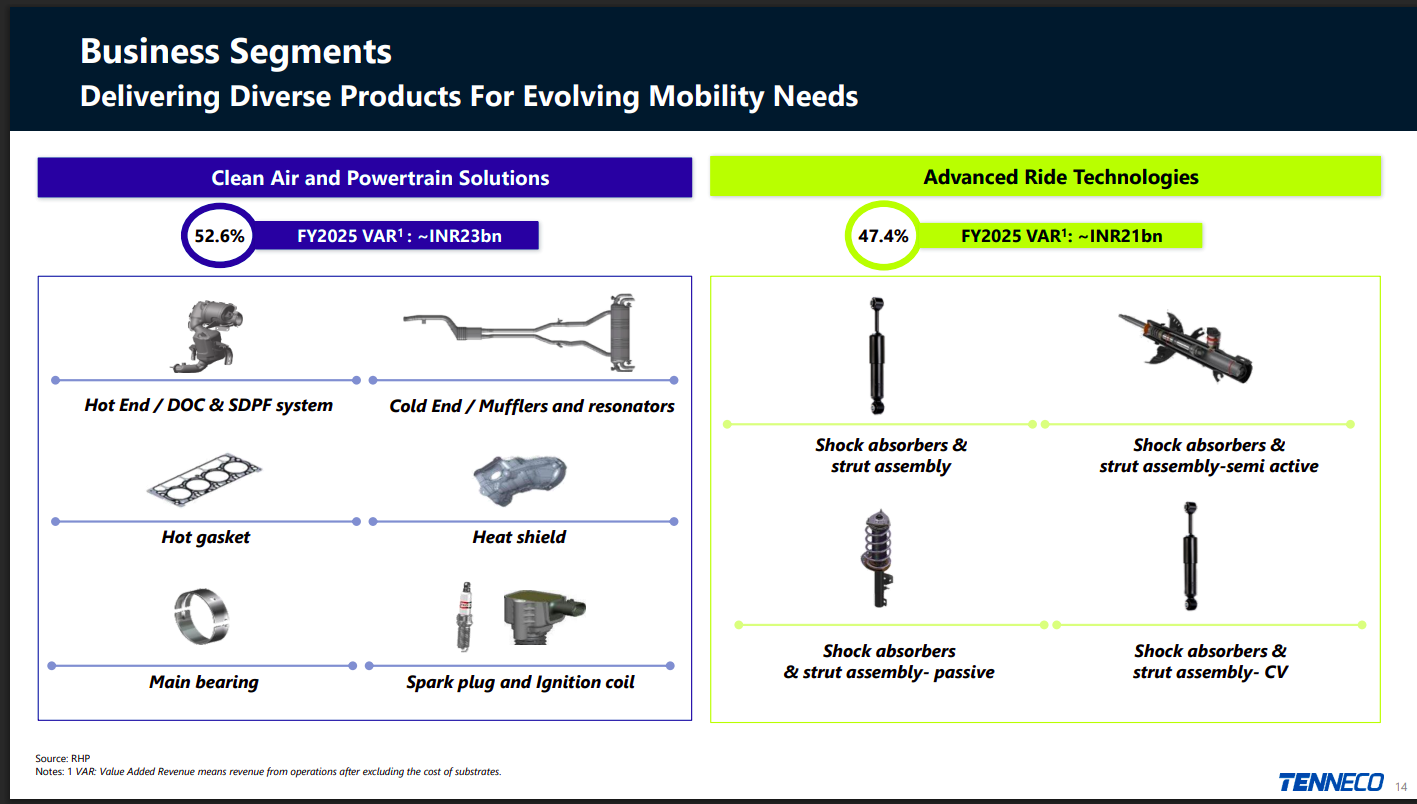
Revenue is split between Clean Air & Powertrain Solutions (52.6%, ~₹23 bn VAR) and Advanced Ride Technologies (47.4%, ~₹21 bn VAR). The portfolio spans emission systems, mufflers, bearings, spark plugs, and a wide range of shock absorbers and strut assemblies.
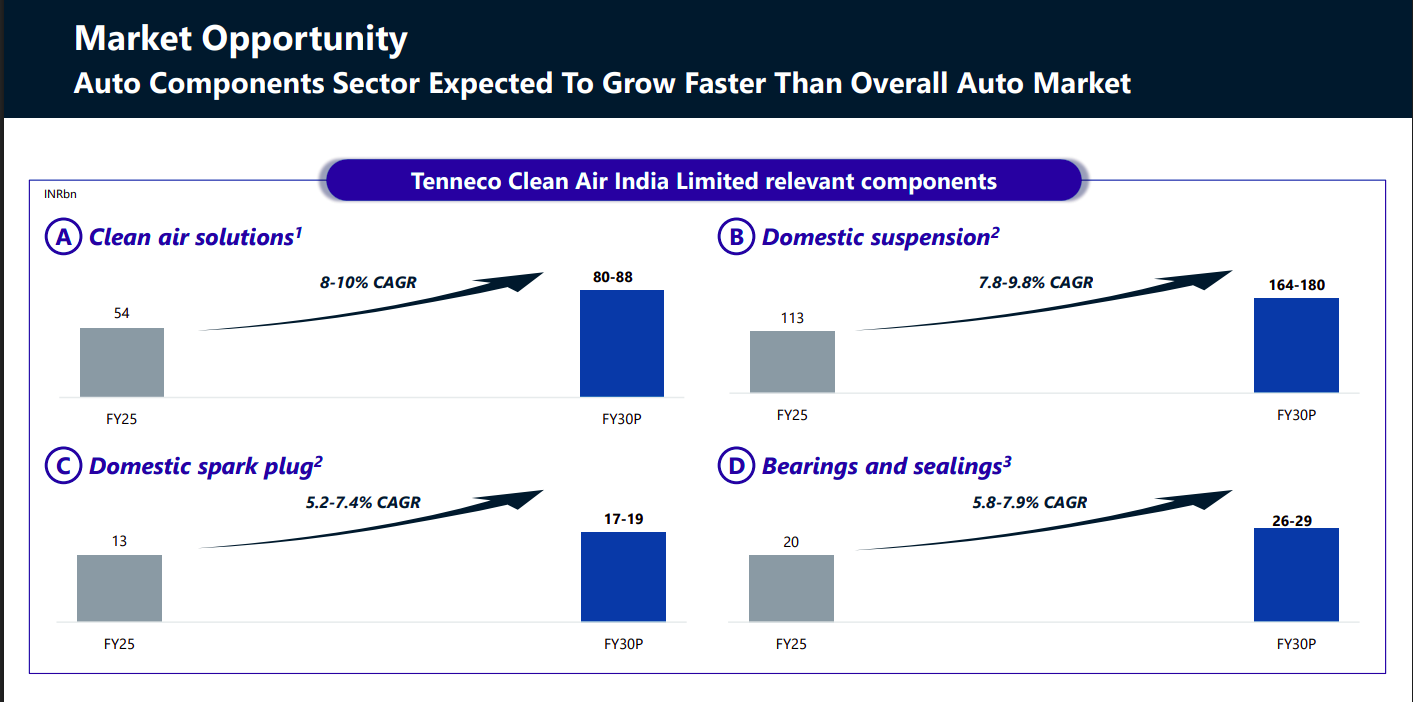
Key component categories are expected to outpace overall auto growth, with Clean Air Solutions and Domestic Suspension projected at ~8–10% CAGR through FY30. Bearings, sealings, and spark plugs also show steady mid-to-high single-digit growth visibility.
Chemicals
Polyplex Corporation | Small Cap | Chemicals
Polyplex Corporation Limited is a global leader in the manufacturing of polyester films with two plants in India. It offers a wide range of thin and thick PET films with various surface properties for diverse applications. The company also produces BOPP, Blown PP/PE, and CPP films in advanced facilities, along with value-added products through downstream capabilities like Metallizing and Holography.
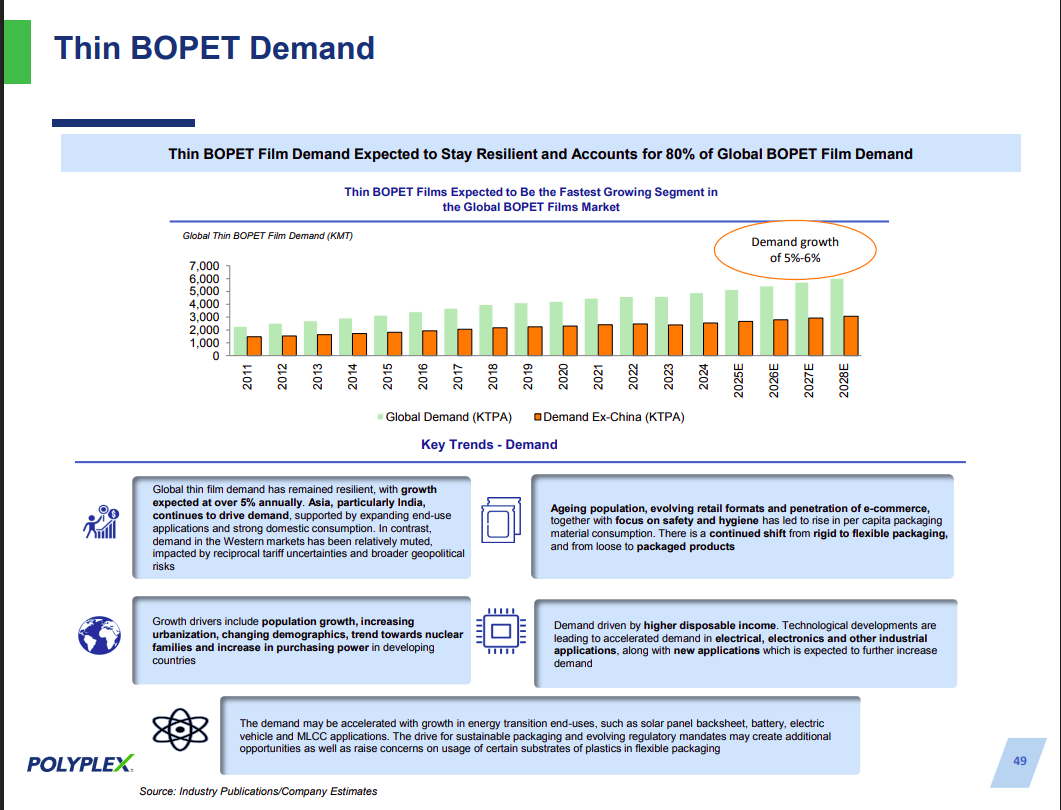
Most new thin BOPET capacity additions are concentrated in China, with limited spillover into SEA markets. Ex-China utilization is expected to remain stable, and rationalization of older lines should support medium-term utilization. Global capacity is projected to grow at ~8% CAGR vs ~5% ex-China.
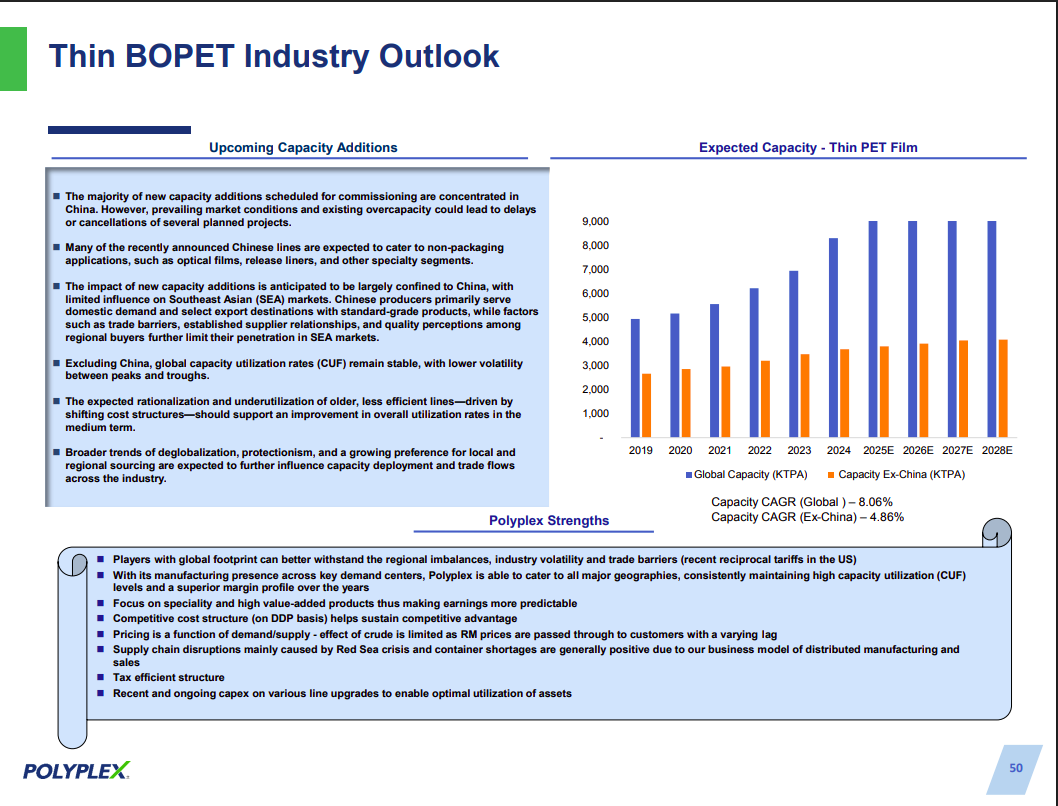
Thin BOPET demand remains resilient, accounting for ~80% of global BOPET demand, with expected growth of 5–6%. Growth is driven by flexible packaging, e-commerce, urbanization, higher disposable income, and emerging energy applications like EVs and solar.
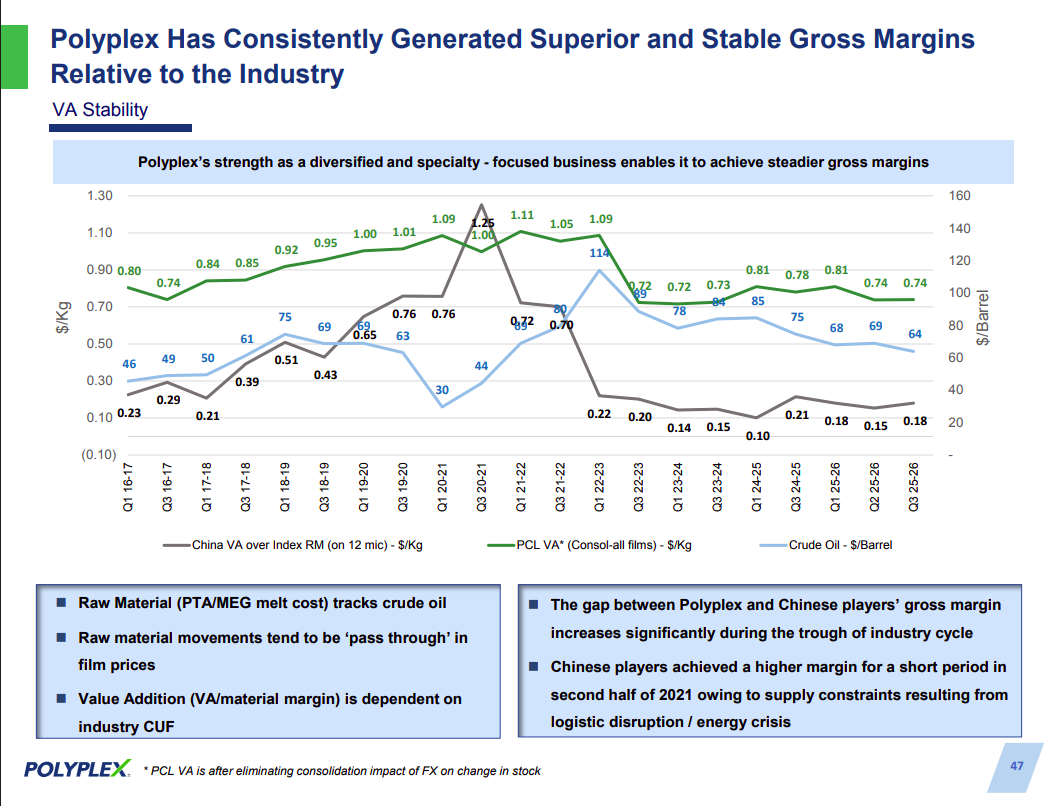
Polyplex has delivered more stable and superior value-added margins versus industry peers, supported by specialty focus and diversified operations. Margin volatility in Chinese players widened during downcycles, highlighting Polyplex’s resilience.
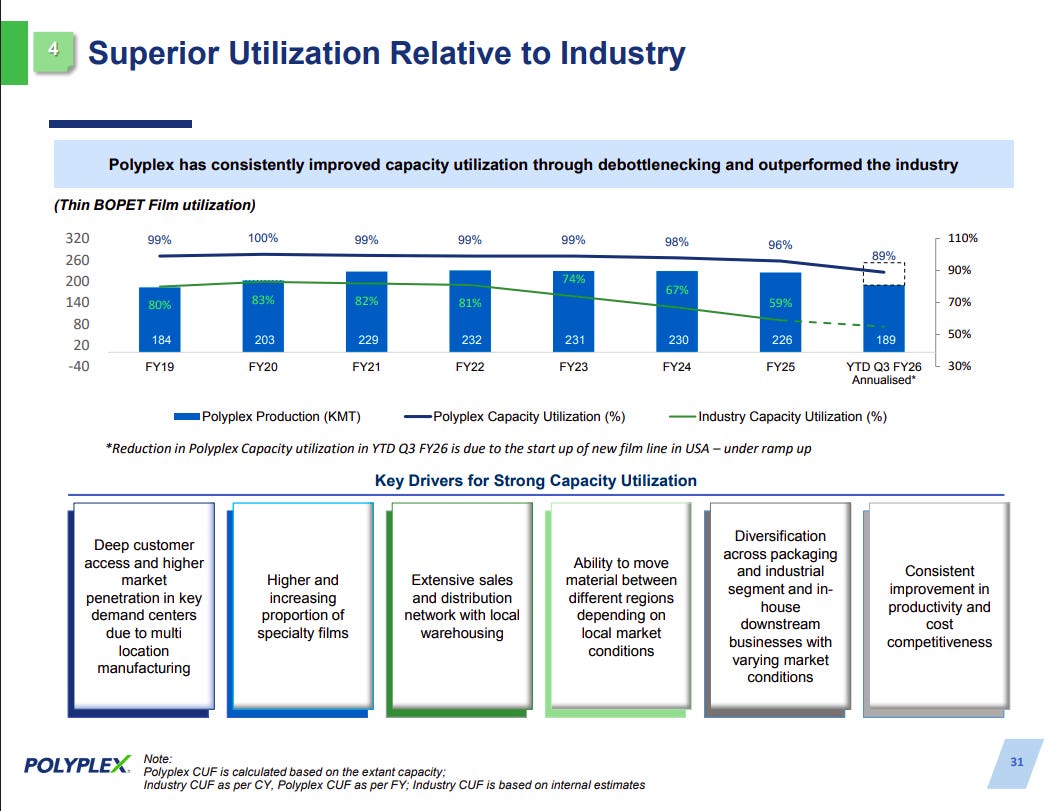
Polyplex consistently maintained high capacity utilization (~96–100%) compared to industry averages, even during cyclical downturns. Multi-location manufacturing, specialty mix, strong distribution, and productivity gains support sustained CUF leadership.
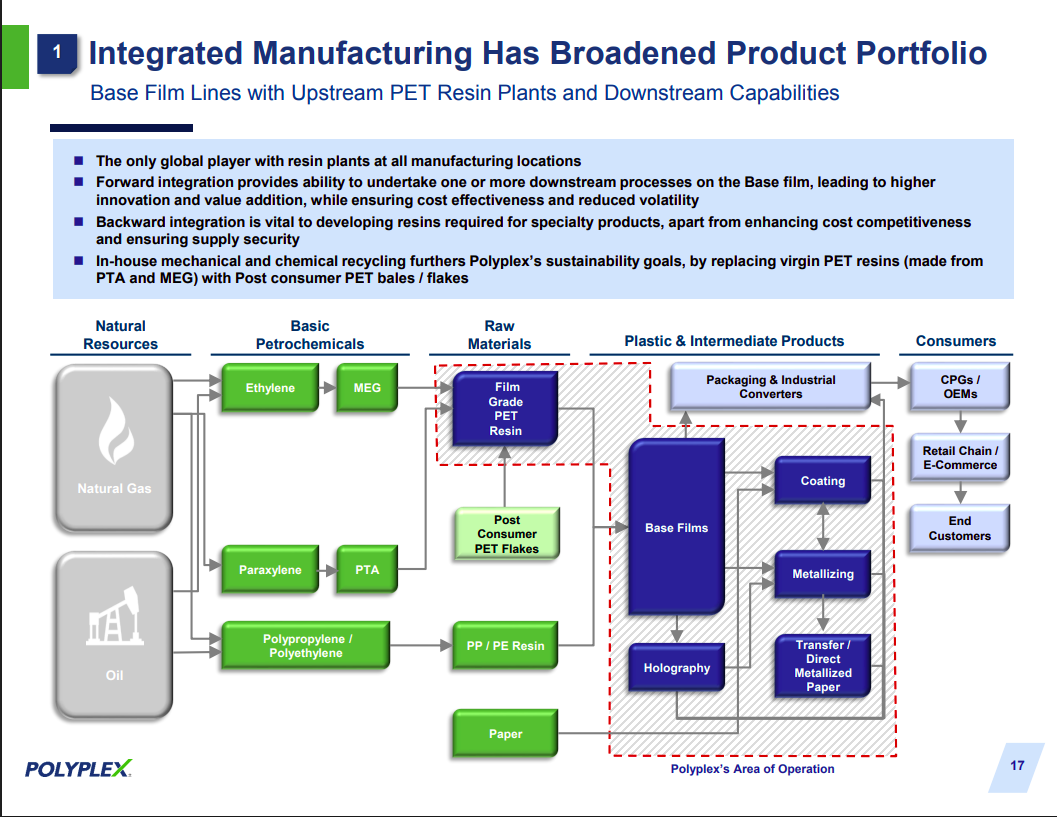
Polyplex’s backward integration—from PET resin to base films and downstream value-added products—enhances cost control, supply security, and innovation. In-house recycling and diversified end-use exposure strengthen margins and reduce volatility across cycles.
FMCG
Britannia Inds | Large Cap | FMCG
Britannia Industries is a prominent food products company in India, manufacturing popular brands like Good Day, Tiger, NutriChoice, Milk Bikis, and Marie Gold. Their diverse product portfolio consists of Biscuits, Bread, Cakes, Rusk, Cheese, Beverages, Milk, and Yoghurt, making them a household name.
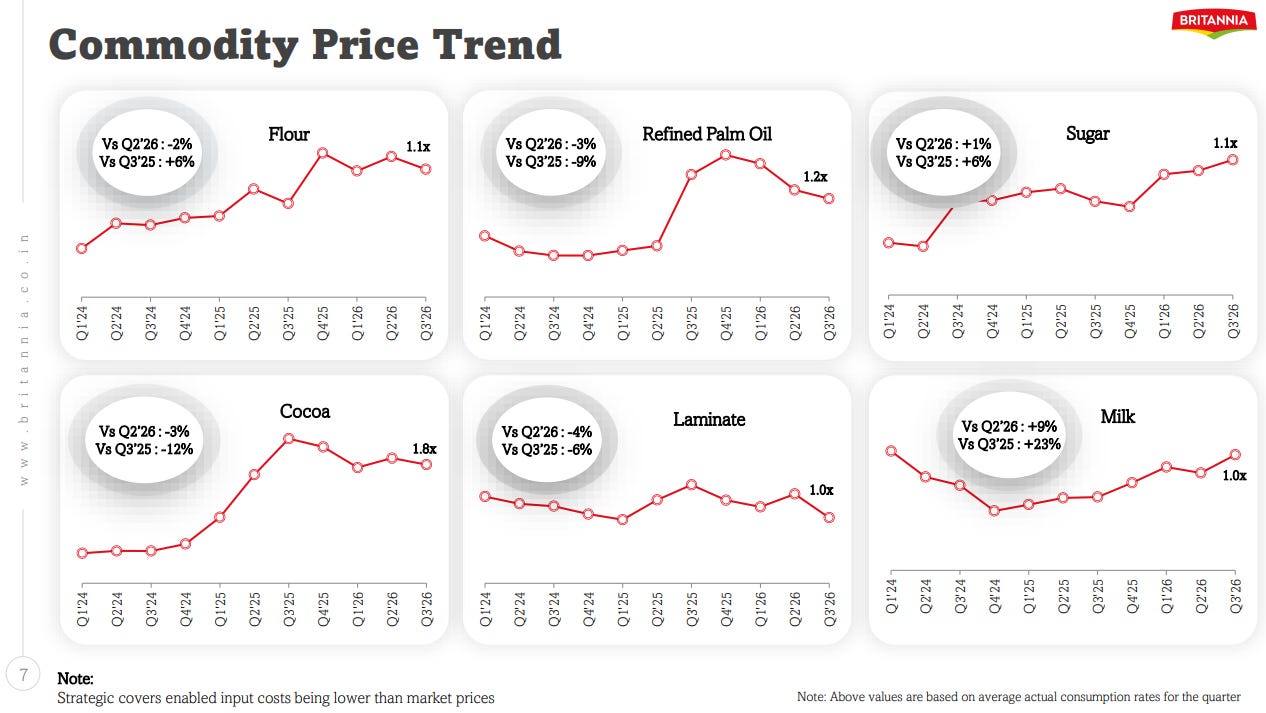
Britannia tracks prices for six key raw materials that go into their products. Flour is down 2% versus the previous quarter but up 6% year-on-year, while refined palm oil has dropped 3% and 9% respectively. Sugar and milk have seen price increases, with milk jumping 9% compared to last quarter and 23% year-on-year. The company notes that strategic procurement deals have helped them lock in costs below prevailing market rates, giving them some buffer against commodity inflation.
Radico Khaitan | Mid Cap | FMCG
Radico Khaitan Limited (RKL) is a prominent manufacturer of Indian Made Foreign Liquor (IMFL) in India, tracing its origins back to 1943 as Rampur Distillery. It has expanded to become a major bulk spirits supplier and trades in a variety of alcoholic products, catering to both domestic and international markets.
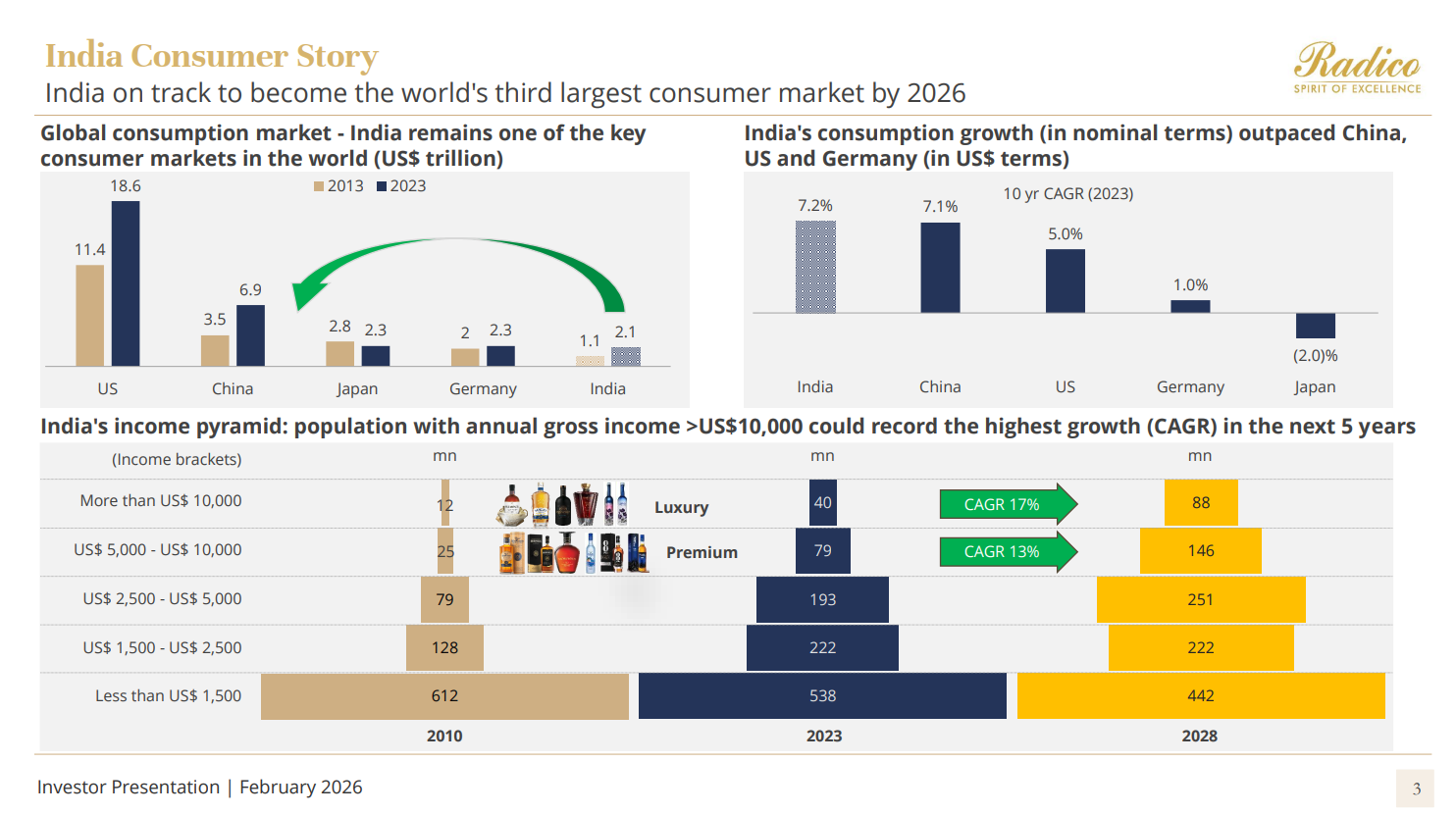
India’s consumer market has nearly doubled from $1.1 trillion in 2013 to $2.1 trillion in 2023, and it’s on track to become the world’s third-largest by 2026. The country’s consumption growth of 7.2% over the past decade has outpaced major economies like China, the US, and Germany. The real opportunity lies in the income pyramid, where the population earning over $10,000 annually is expected to grow at 17% CAGR through 2028, expanding from 40 million to 88 million people. This upward shift in income levels is creating a bigger market for premium and luxury products.
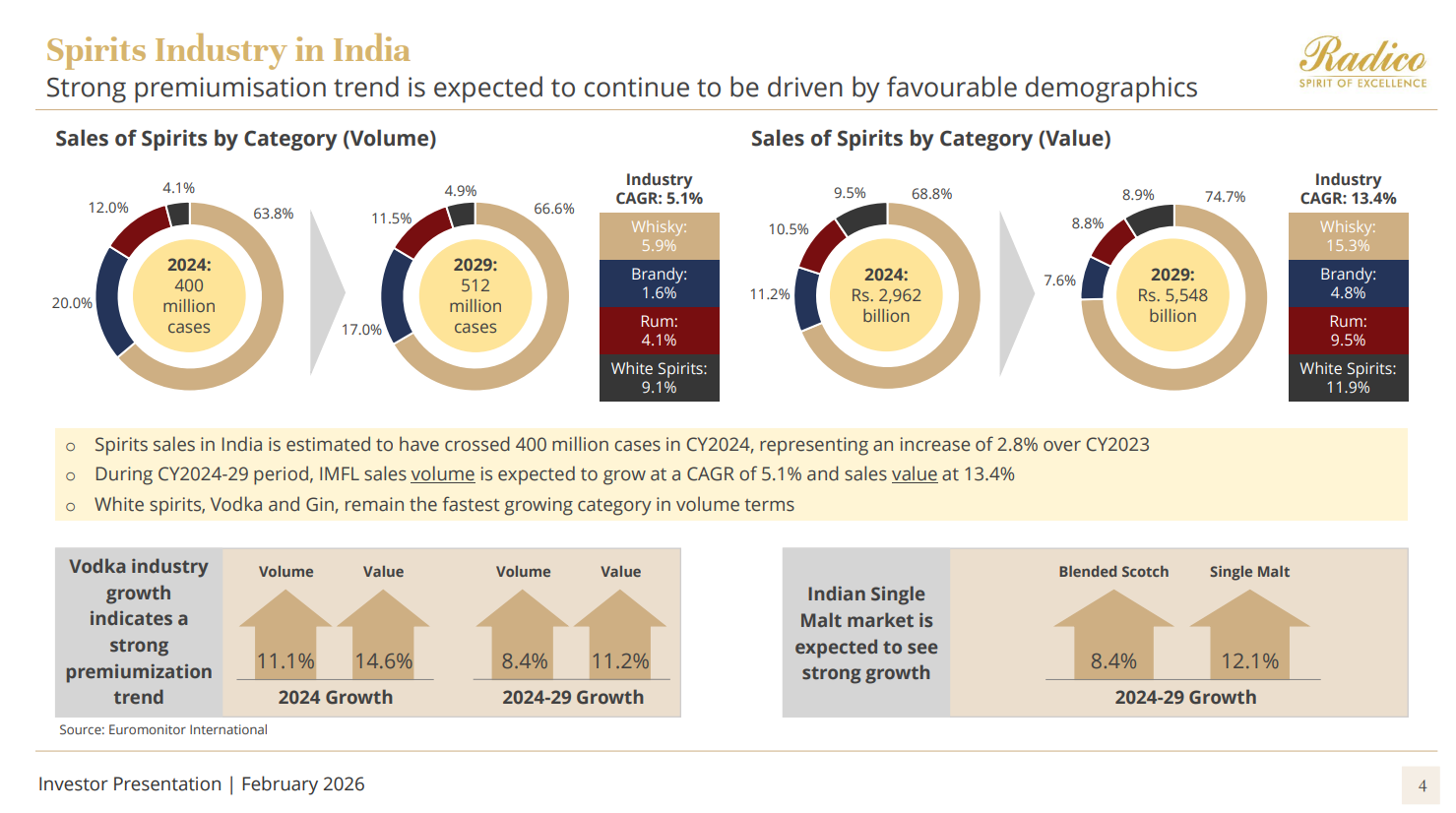
India’s spirits industry is growing steadily, with sales estimated to have crossed 400 million cases in 2024, up 2.8% from the previous year. While volume is expected to grow at 5.1% annually through 2029, value growth is significantly higher at 13.4%, pointing to a strong premiumization trend as consumers trade up to better products. Whisky dominates the market but white spirits like vodka and gin are the fastest growing categories, with vodka showing particularly strong growth of 14.6% in value terms for 2024. The Indian single malt market is also expanding rapidly, expected to grow at 12.1% annually, reflecting rising consumer interest in premium spirits.
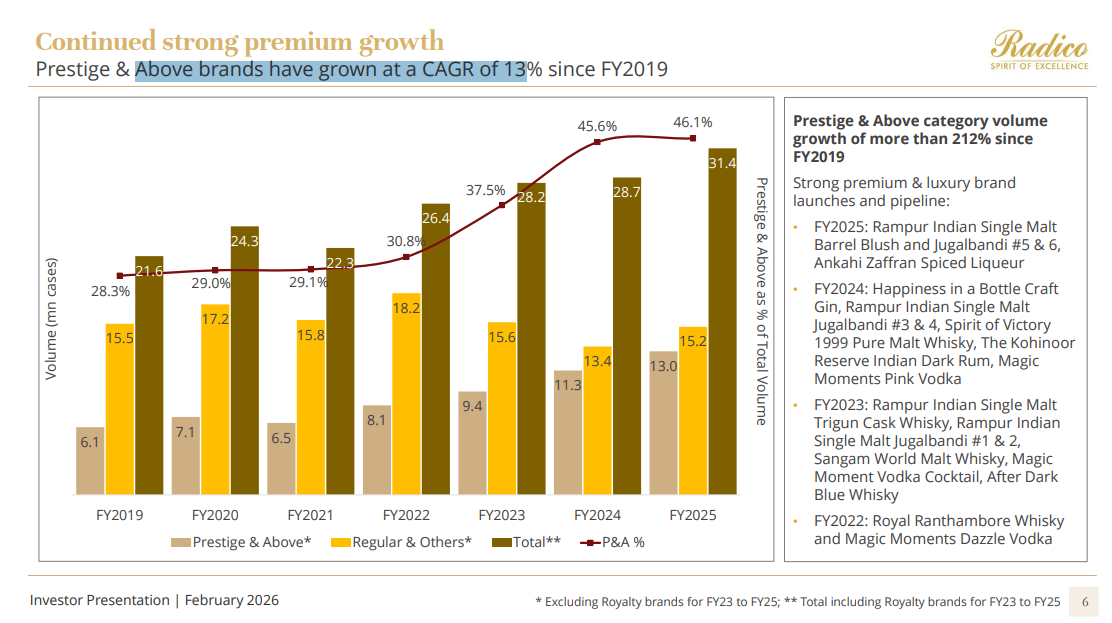
Radico Khaitan’s prestige and above portfolio has been growing at 13% annually since 2019, significantly outpacing their regular brands. The premium segment’s share of total volume has jumped from 28.3% in FY2019 to 46.1% in FY2025, now accounting for nearly half of all sales. The company has been consistently launching new premium and luxury products, including Indian single malts like Rampur, craft spirits, and premium vodkas across recent years. This shift towards higher-priced products explains why the company is seeing stronger value growth compared to volume growth in the overall spirits market.
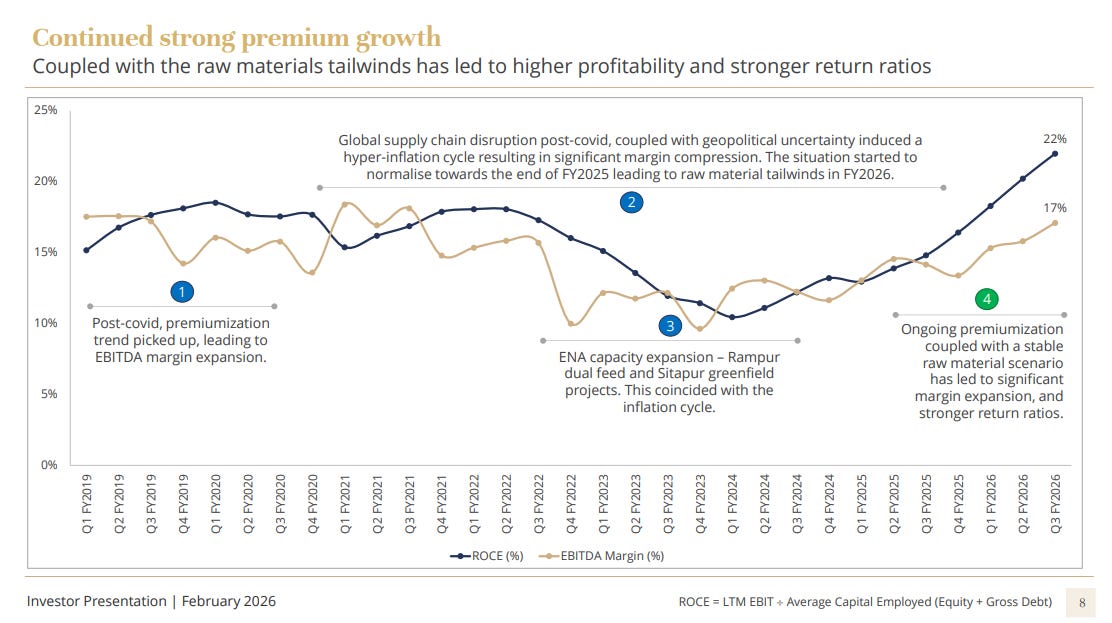
The company’s return on capital employed has improved from around 15% in 2019 to 22% by late 2026, driven by premiumization and favorable raw material costs. EBITDA margins initially expanded post-covid due to the premium shift, then dipped during the 2022-2023 inflation cycle when raw material costs spiked. As commodity prices have normalized from late 2025 onwards, margins have recovered and expanded to around 17%. The combination of ongoing premiumization and stable input costs has resulted in significantly stronger profitability and return ratios for the business.
Financial Services
CRISIL | Mid Cap | Financial Services
Crisil is a leading credit rating agency in India, offering bond ratings, bank loan ratings, SME ratings, and other grading services. It provides global business insights through collaborative research and analytical excellence, helping leaders and policymakers shape future strategies.
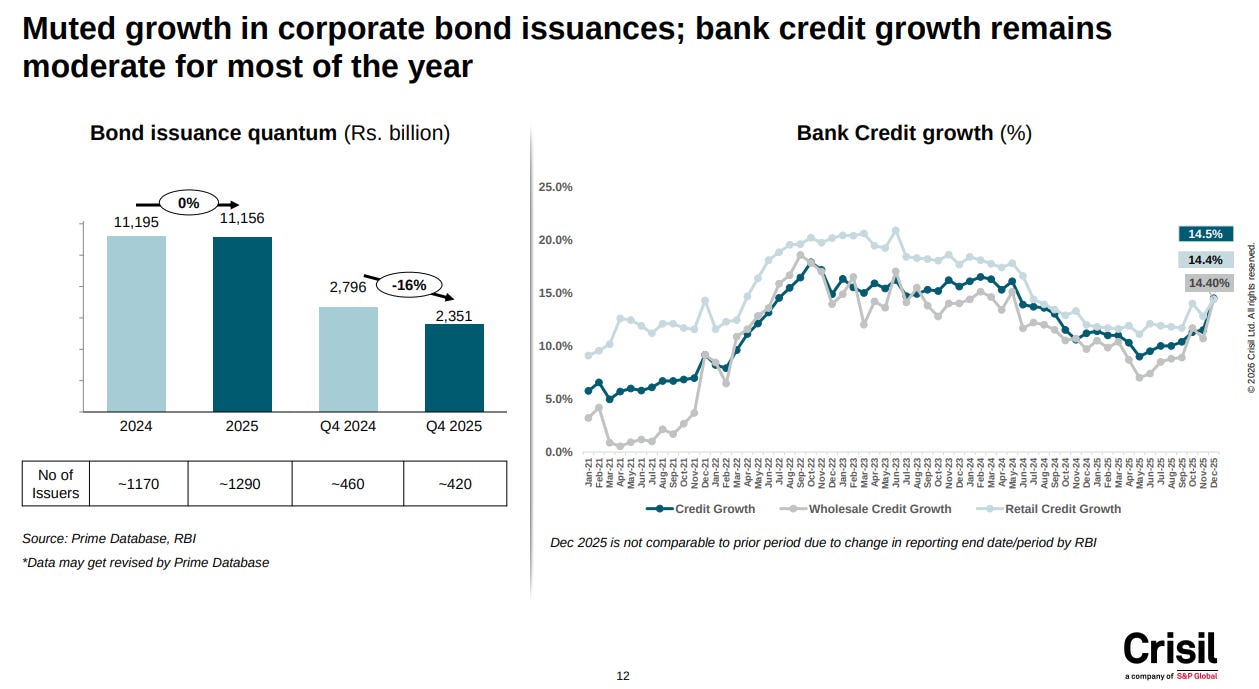
Corporate bond issuances have stayed flat, moving from Rs. 11,195 billion in 2024 to Rs. 11,156 billion in 2025, with the number of issuers dropping from around 1,170 to 1,290. On a quarterly basis, Q4 2025 saw bond issuances decline 16% to Rs. 2,351 billion compared to Q4 2024. Bank credit growth has remained moderate through most of the year, hovering in the 10-12% range before picking up slightly to 14.5% by late 2025. Overall credit growth shows a similar pattern, indicating that companies are neither aggressively borrowing from banks nor significantly tapping the bond market.
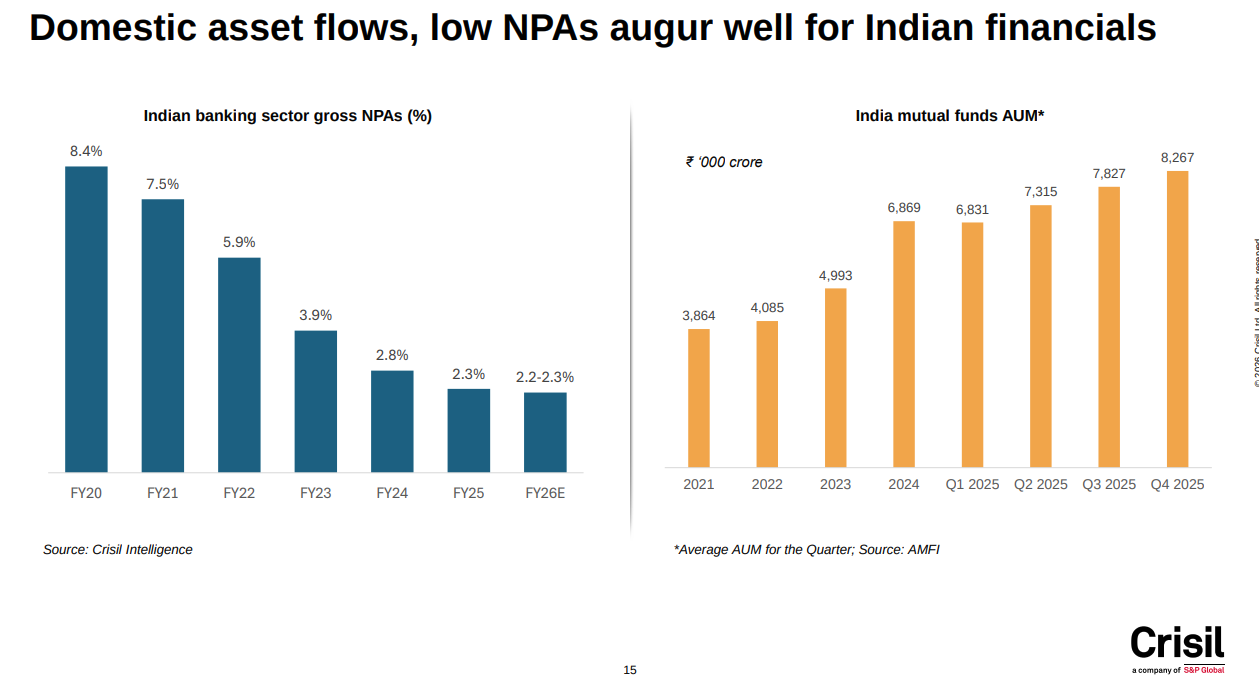
Indian banks have seen their gross NPAs drop steadily from 8.4% in FY20 to an estimated 2.2-2.3% in FY26, indicating much healthier loan books and better asset quality. At the same time, mutual fund assets under management have more than doubled from Rs. 3,864 crore in 2021 to Rs. 8,267 crore by Q4 2025. This shows strong domestic savings flowing into the financial system through mutual funds, while banks are dealing with cleaner balance sheets. Together, these trends point to a robust environment for Indian financial institutions with more capital available and fewer bad loans to worry about.
KFin Technologies | Small Cap | Financial Services
KFin Technologies Limited is a technology-driven financial services platform offering comprehensive solutions to the capital markets ecosystem in India. They provide services to asset managers and corporate issuers across asset classes. With a focus on transaction origination and processing, they cater to mutual funds and private retirement schemes in Malaysia, Philippines, and Hong Kong. The company delivers essential services such as SaaS-based transaction management, compliance solutions, data analytics, and digital services to asset managers globally.
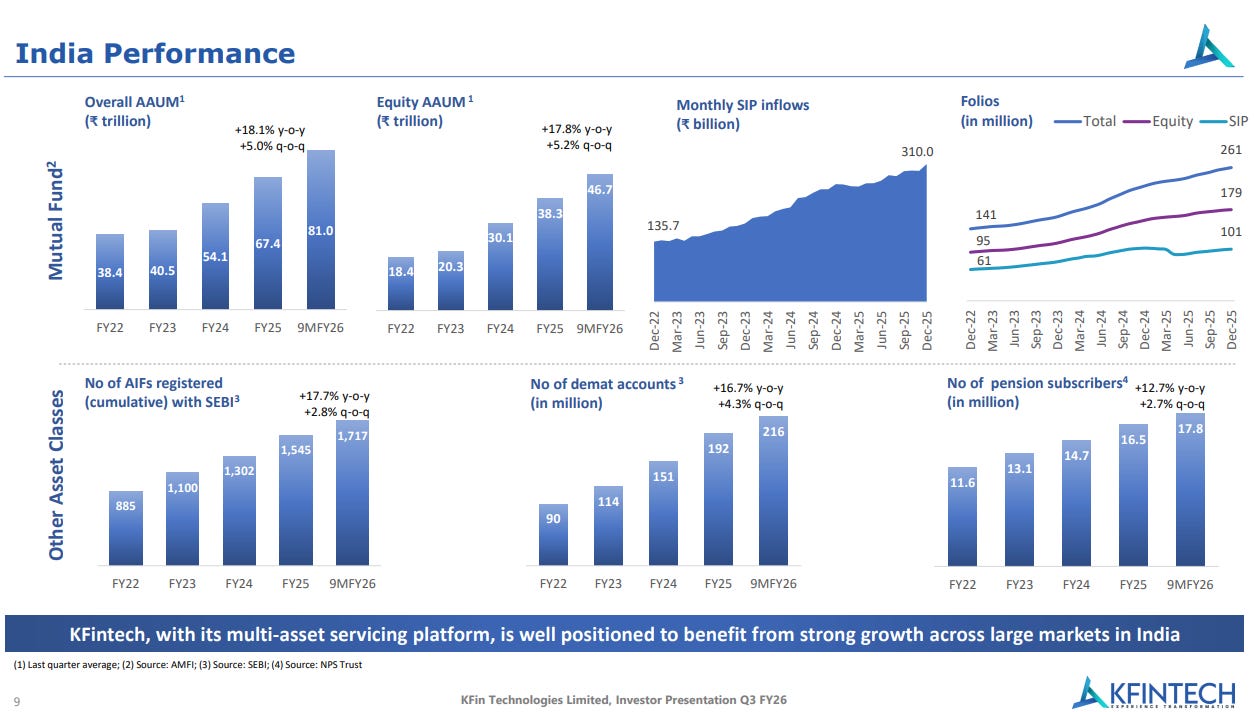
KFin Technologies has seen strong growth across all metrics in India’s mutual fund and financial services sector. Overall assets under management and unit services have grown 18.1% year-on-year to Rs. 81 trillion, while equity assets have jumped 17.8% to Rs. 46.7 trillion. Monthly SIP inflows have surged to Rs. 310 billion in December 2025, with total folios reaching 261 million, equity folios at 179 million, and SIP folios at 101 million. The number of registered alternative investment funds has grown to 1,717, demat accounts to 216 million, and pension subscribers to 17.8 million. KFin’s multi-asset servicing platform positions it well to benefit from this broad-based expansion across large markets in India.
Tourism & Hospitality
Indian Hotel | Mid Cap | Tourism & Hospitality
IHCL operates and manages hotels, palaces, and resorts, along with air and institutional catering. It offers a range of brands including Taj, Vivanta, and Ginger, focusing on blending Indian hospitality with world-class service. The company is scaling its brands and innovating in Food and Beverage concepts to enhance customer experiences.
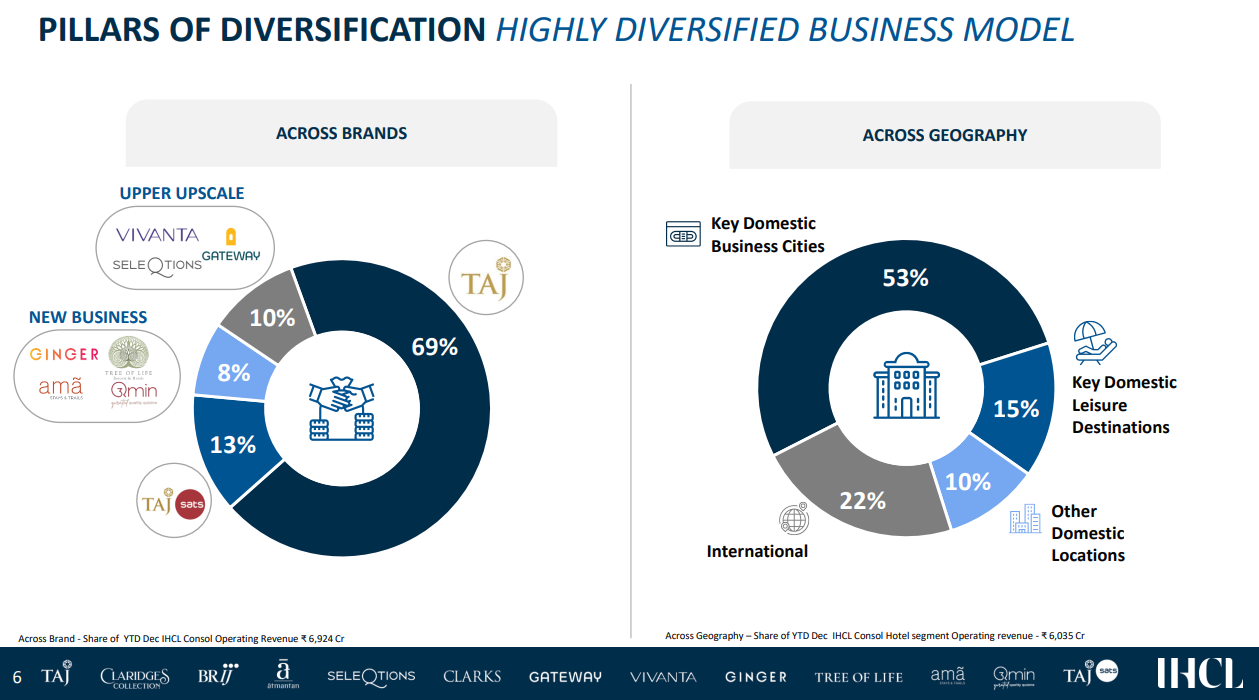
Indian Hotels has diversified its business across brands and geographies to reduce concentration risk. On the brand side, the flagship Taj contributes 69% of revenue, while upper upscale brands like Vivanta and Gateway add another 10%, and newer businesses account for 21%. Geographically, key domestic business cities drive 53% of revenue, followed by international markets at 22%, domestic leisure destinations at 15%, and other domestic locations at 10%. This spread ensures the company isn’t overly dependent on any single brand or location for its earnings.
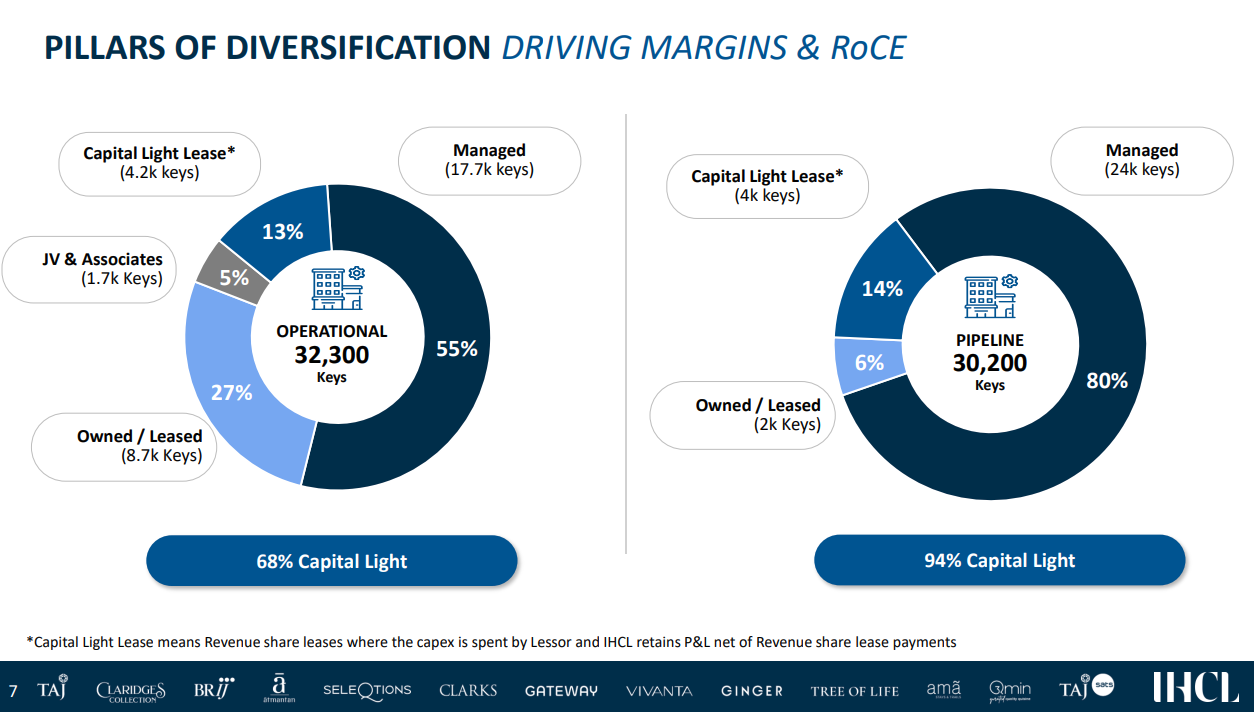
Indian Hotels operates a mix of owned and asset-light models to drive margins and returns. Of the 32,300 operational keys, 55% are managed properties, 27% are owned or leased, 13% are capital light leases, and 5% are joint ventures, making 68% of the portfolio capital light overall. In the pipeline of 30,200 keys under development, the asset-light share is even higher at 94%, with 80% being managed properties and 14% being capital light leases. This shift towards managing properties rather than owning them means the company can grow its footprint without tying up large amounts of capital, leading to better returns on invested capital.
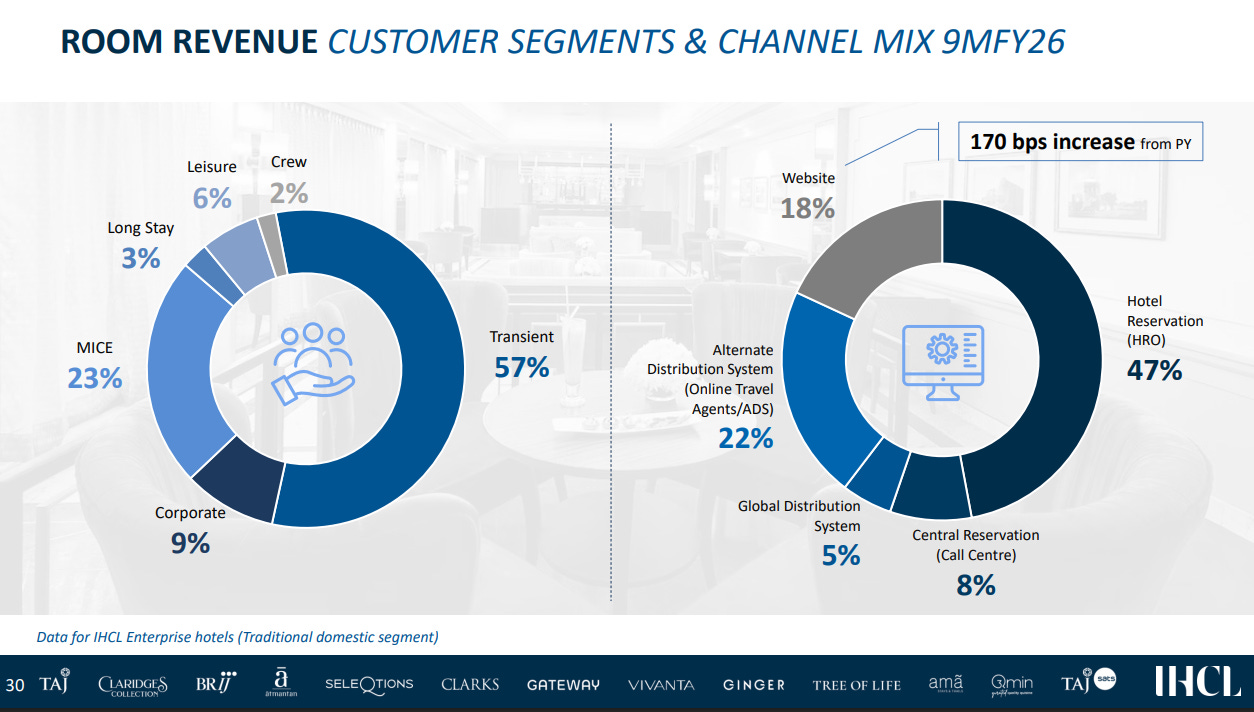
Indian Hotels gets most of its room revenue from transient guests at 57%, followed by MICE at 23%, corporate at 9%, leisure at 6%, long stay at 3%, and crew at 2%. On the distribution side, direct bookings through the hotel reservation system contribute 47%, while the company’s website accounts for 18%, up 170 basis points from the previous year. Online travel agents and alternative distribution systems make up 22%, with the remaining coming from global distribution systems and call centers. The growing share of direct bookings, especially through the website, is positive as it means lower commission costs and better margins for the company.
That’s it for now! Your feedback will really help shape how Points and Figures evolves. Drop it down in the comments below!
Quotes in this newsletter were curated by Meher & Vignesh.
Disclaimer: We’ve used AI tools in filtering and cleaning up the quotes from the images so there maybe some mistakes. Now, if you are thinking why we are using AI, please remember that we are just a small team of 5 people running everything you see on Zerodha Markets 😬 So, all the good stuff is human and mistakes are AI.
We’re now on Reddit!
We love engaging with the perspectives of readers like you. So we asked ourselves - why not make a proper free-for-all forum where people can engage with us and each other? And what’s a better, nerdier place to do that than Reddit?
So, do join us on the subreddit, chat all things markets and finance, tell us what you like about our content and where we can improve! Here’s the link — alternatively, you can search r/marketsbyzerodha on Reddit.
See you there!
Points and Figures is run by the same team that creates The Daily Brief and Aftermarket Report.