

Hi, I’m Kashish and I work on Plotlines.
It builds on Chatter, but with a more structured lens. Instead of looking at management commentary from earning concalls in isolation, we track a single theme across companies and over time to connect the dots. The goal is to piece together how narratives evolve, and surface the deeper structural shifts shaping industries.
Today, we cover evolution of India’s E-waste rules.

Every year, India throws away the equivalent of a small mountain of electronics. In FY 2024–25, the Central Pollution Control Board counted 13.97 lakh tonnes of e-waste — discarded phones, televisions, refrigerators, cables, batteries — generated across the country. That’s up from 7.08 lakh tonnes in 2017–18. Almost double in seven years. By total volume, India is now the third-largest e-waste generator in the world, behind only China and the United States.
The rules to handle this have technically existed since 2012. But having rules and enforcing them have been, for most of that time, entirely different propositions. The story of India’s e-waste framework is the story of a government that kept tightening its grip — through mandatory targets, customs enforcement, a digital certificate trading platform, and now a minimum floor price contested in court — until the industry, reluctantly, started moving. What follows is that story, told through the people building and paying for the new system.
The Paper Tiger (2012–2016)
The first iteration of India’s e-waste rules arrived in 2012 and operated on an optimistic principle: that producers of electronics would voluntarily take responsibility for what happened to their products at end of life.
It did not work.
“In India, the EPR policy first came into picture in 2012 where it was voluntarily compliance. Not taken very seriously, right, so no producer essentially wanted to do anything.”
— Nitin Gupta, Founder and CEO, Attero Recycling | Aug 2025
Extended Producer Responsibility is the idea that the company which profits from selling a product should bear responsibility for what happens to it when the consumer is done. As a principle, it’s intuitive. As a regulatory mechanism, it requires enforcement. The 2012 rules provided the principle without the enforcement.
Four years later, the government upgraded from voluntary to mandatory.
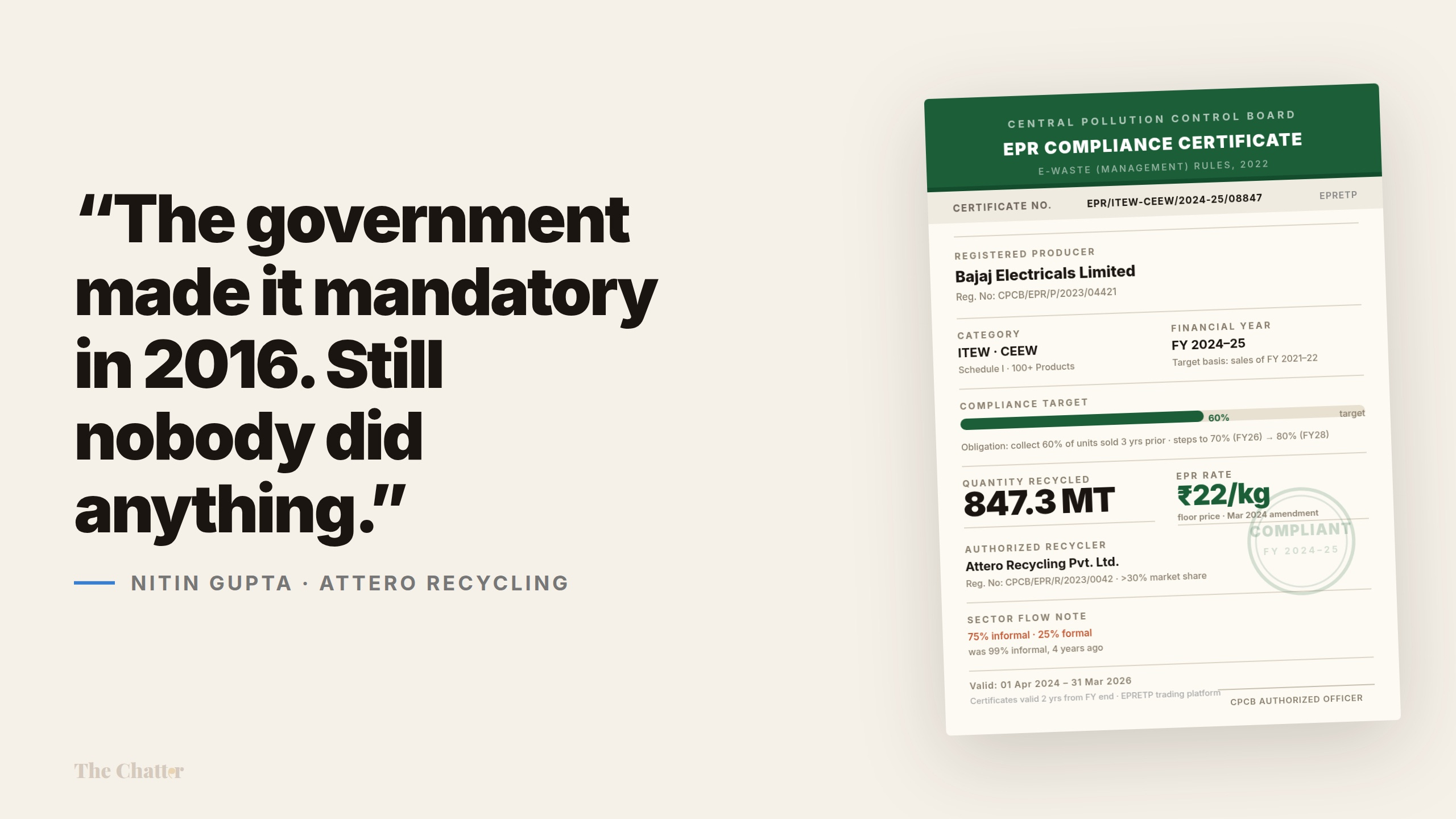
“And then the government actually made it mandatory compliance in 2016. Still nobody did anything...”
— Nitin Gupta, Founder and CEO, Attero Recycling | Aug 2025
The 2016 rules set escalating collection targets — 10% of historical sales in the first year, stepping up to 70% by 2022–23. But the rules had a structural gap: verification. Producers self-reported their compliance. Penalties were modest. The informal sector — hundreds of thousands of waste pickers, kabadiwalas, and crude dismantling units operating across Indian cities — continued to handle the overwhelming majority of e-waste, exactly as it always had.
Enforcement finds its teeth (2016–2022)
The breakthrough came not from environmental enforcement but from trade logistics.
“...then the checking of EPR compliance was handed over to customs. So as an OEM, you could not import a product or a subassembly or a component without EPR compliance. That’s when a lot of OEMs started taking it seriously...”
— Nitin Gupta, Founder and CEO, Attero Recycling | Aug 2025
India’s electronics industry runs on imported components. A company that couldn’t clear customs couldn’t sell. Tying EPR compliance to import clearance was the enforcement lever that actually worked — because the cost of non-compliance was no longer an abstract penalty. It was a supply chain shutdown.
The rules continued tightening. In 2019, the scope of products covered under EPR expanded from 21 categories to 30. The E-Waste Management Rules 2022 — notified in November 2022, effective April 1, 2023 — expanded that further to over 100 product categories, adding tablets, GPS devices, modems, air purifiers, medical equipment, solar PV panels and modules, and laboratory instruments, among others.
“So back in 2019 it was 30 products covered under EPR, then they made it 100 products. Then they introduced a platform for trading of these EPR certificates as well and now they’ve introduced the minimum floor pricing right which is in contention in the courts because some OEMs have opposed it.”
— Nitin Gupta, Founder and CEO, Attero Recycling | Aug 2025
The trajectory is worth pausing on: from 21 to 30 to 100+ products; from voluntary to mandatory to customs-enforced; from self-reporting to a digital certificate trading market with a government-set price floor. Each step was a tightening of the system.
What the rules actually ask for?
Before getting into how industry has responded, it’s worth explaining the mechanics — because EPR certificates are doing a lot of work in this story and the concept is less intuitive than it sounds.
An EPR certificate is proof that a certain quantity of e-waste has been collected and scientifically processed by an authorized recycler. Under the E-Waste Management Rules 2022, every producer — any company that manufactures or imports electronics — must meet annual recycling targets based on what it sold in prior years. The current target is 60% of historical sales volume, stepping up to 70% by FY 2025–26 and 80% by FY 2027–28.
A producer can meet its target one of two ways: run its own collection and recycling program, or buy EPR certificates from authorized recyclers who have already done the processing. This certificate-trading mechanism transforms a compliance obligation into a market. CPCB launched its EPR Electronic Trading and Settlement Platform (EPRETP) to host it. Certificates are denominated in kilograms, priced by category, and valid for two years.
As of 2024–25, EPR certificate prices for e-waste range from roughly ₹10 to ₹50 per kilogram, with a minimum floor price of ₹22/kg established by government amendment in March 2024.
The floor price is the live controversy in the system. The logic: without a price floor, certificates could collapse toward zero, making it economically irrational for formal recyclers to invest in infrastructure. The counterargument, advanced by several of the country’s largest electronics brands, is that the floor distorts the market and constitutes an unfair financial burden.
In April 2025, a group of major OEMs — Daikin, Samsung, LG, Havells, and Voltas among them — challenged the floor pricing mechanism in the Delhi High Court. The case is ongoing. It captures the central tension in the system: the government is trying to make formal recycling economically viable; the brands whose products create the waste are pushing back on what that costs them.
What compliance looks like in practice?
For appliance and consumer electronics brands, the shift from theoretical compliance to actual accounting showed up in earnings calls from around FY 2023–24 — roughly when CPCB moved from accepting broad industry data to issuing specific, company-level targets.
“You would be aware that the government had brought out the E-waste regulation particularly consumer durables a few years back but at that time there was no clarity on how that should be treated. Now the government / CPCB has come out with a lot of clarity and we all the industry players have submitted all sort of data so they have come out with the specific number which every company needs to comply with.”
— Rajiv Goel, Executive Director, Havells India | Q3 FY24
This is the moment the rules became real for companies. Until CPCB issued company-specific numbers, the obligation existed but the liability was undefined. Once defined, it had to be provisioned. And the quantum is not small — nor is it stable.
Bajaj Electricals, whose lighting and appliance business generates significant e-waste obligation under the Consumer Electrical and Electronics Equipment category, gave a clean accounting of where it stands.
“So EPR for this year is about Rs. 9.5 crores and last year also was similar. Going forward next year it will be a charge of about Rs. 18 crores.”
— E.C. Prasad, CFO, Bajaj Electricals | Q4 FY25
The cost is essentially doubling. And this isn’t an anomaly — it’s arithmetic. EPR targets step up every two years; the compliance cost scales accordingly. For Havells, a company with broader product categories and a larger sales base, EPR has graduated into a named line item alongside commodity inflation and energy efficiency regulation changes.
“I think it is consumed, and we are hoping for better contribution margins. It’s not comparable as against last year because EPR liabilities have also increased in the current year, which obviously when the season comes, when we are in a position to pass on that price to the market, we’ll have to do that. But right now, because of low season, we’ve also been restrained to do so.”
— Anil Rai Gupta, Chairman and MD, Havells India | Q2 FY26
“We remain optimistic about a gradual recovery in demand. However, we are cognizant of the industry headwinds such as cost increases on account of commodity inflation, BEE changes, e-waste, etc. We are in the process of taking calibrated price hikes and enhancing operational efficiency.”
— Anil Rai Gupta, Chairman and MD, Havells India | Q3 FY26
The ‘BEE changes’ reference is to Bureau of Energy Efficiency star rating upgrades for appliances, which impose their own compliance costs. Companies are now managing a convergence of regulatory cost pressures — and e-waste is clearly one of them. The costs will eventually move into product prices. The question is timing.
Amara Raja’s ₹700 Crore bet
The producer-side response of absorbing costs, buying EPR certificates and timing price increases is one approach to the new compliance reality. Amara Raja Energy & Mobility chose a different one.
Battery companies operate under a parallel framework to the E-Waste Rules: the Battery Waste Management Rules 2022, notified in August 2022 and effective from February 2023. The structure mirrors the e-waste system — EPR registration, collection targets, certificate trading — but the targets are steeper. For automotive and EV batteries, the requirement is 90% collection and recycling by FY 2026–27, with minimum recycled content mandates in new batteries from FY 2027–28 onwards.
Amara Raja is one of India’s two largest lead-acid battery manufacturers. For a company whose entire business runs on lead — buying it, forming it into batteries, selling those batteries, and now bearing regulatory responsibility for what happens when they die — in-house recycling isn’t just a compliance option. It’s a raw material strategy.
“The refining operations... are expected to commence the commercial production in the month of September or October. And then we’ll be using that lead coming from that factory for our purposes. And the battery breaking operations are expected to commence the production, maybe about four, five months after the refining operations are completed.”
— Y. Delli Babu, CFO, Amara Raja Energy & Mobility | Q1 FY25
Lead-acid battery recycling runs in two stages: battery breaking — shredding spent batteries to separate lead plates, plastic casings, and acid — and lead refining, which smelts the recovered material into usable metal. Amara Raja’s facility, called ARCSPL, was being built in phases. Refining came first; battery breaking would follow. This sequencing matters because a refinery without its own breaking operation still buys pre-processed lead from the market. Only once both stages are integrated does the company control the full loop.
The investment rationale is direct.
“...once we do the entire 1,50,000 tons, that is what is being envisaged in that particular location, that should give us close to about 30% of our overall requirement from our own internal recycling sources. So that’s the objective of that investment.”
— Y. Delli Babu, CFO, Amara Raja Energy & Mobility | Q1 FY25
Phase 1 is approximately ₹500 crore; the board approved an additional ₹200 crore for Phase 2. At full scale, the plant would supply 30% of Amara Raja’s lead from recycled material — insulating that portion of its raw material from London Metal Exchange (LME) price volatility and from the margins lost when sending scrap to outside smelters.
By Q3 FY25, the refining phase had commenced commercial operations.
“Then on the recycling plant in this quarter, we have commenced the 1st Phase of commercial operations of the refining capacity of 50,000 tons, we have started the commercial operations in the current quarter, and it will continue to operate at a full capacity for the next quarter as well. And then we are expecting to start the smelting operations, that is the battery breaking operations, sometime towards the end of Q1 of next financial year.”
— Y. Delli Babu, CFO, Amara Raja Energy & Mobility | Q3 FY25
Then came the harder math.
“Amara Raja is running a battery collection program over a period of years. And today, we are able to collect 75% to 80% of the batteries sold. As per the BWMR regulations from the current financial year, we have an obligation to collect 90% of the batteries sold 3 years ago. This percentage was 70% till last financial year, and we met our obligations.”
— Swajitha Rapeti, Head, Corporate Finance, Amara Raja Energy & Mobility | Q2 FY26
A 10–15% shortfall in collection means buying EPR certificates. And buying EPR certificates means provisioning for a cost that is uncertain today and likely to rise.
“We are also buying our EPR credit wherever there is a shortfall, and we anticipate the demand for this EPR certificate may go up in future. Hence, on a prudent basis, we have provided for EPR credit cost in our books based on our revised estimates on scrap collection program. Going forward, as we ramp up our collections, provided the scrap recycling price is competitive with the LME rates, these provisions may come down or even may not be required.”
— Swajitha Rapeti, Head, Corporate Finance, Amara Raja Energy & Mobility | Q2 FY26
The clause ‘provided the scrap recycling price is competitive with the LME rates’ contains the whole economics of formal battery recycling in one sentence — and it’s worth unpacking, because it explains why regulation alone can’t fix the supply problem.
The LME — London Metal Exchange — is the global price benchmark for industrial metals. Lead trades on the LME the same way oil trades on Brent: it sets the reference price that every buyer and seller in the world uses to negotiate. When Amara Raja buys lead as a raw material, it pays something close to LME spot. When it processes scrap through ARCSPL, the value of the lead it recovers is also measured against LME. So the economics of recycling are simple: if your cost to process scrap into usable lead is lower than the LME price, recycling makes sense. If it’s higher, you’re better off just buying virgin lead at market price.
The problem is what this does to scrap collection. A formal recycler — paying GST, running compliant acid disposal, employing workers with safety equipment, maintaining regulatory certifications — carries significant overhead. That overhead limits how much it can afford to pay for used batteries at the collection point and still turn a profit after processing. The informal sector carries almost none of these costs. No GST. No compliant disposal. Often no safety equipment at all. Their lighter cost structure means they can offer battery sellers — auto repair shops, retailers, consumers — a higher price for scrap than formal recyclers can while still making money.
This is the outbidding problem. Batteries flow to whoever pays more. In most parts of India, that is still the informal operator. Amara Raja’s collection program falls short because the scrap it needs is being outbid at the source. The gap then has to be closed with EPR certificate purchases — which is a financial cost, not a recycling solution.
Amara Raja’s own recycling plant partially changes the equation. When you process your own scrap, you capture the full value of recovery without paying a middleman. You also have more control over what you pay to collect — because you’re not relying on an external recycler’s pricing. The question, as Delli Babu frames it, is whether the plant’s recovery ratios are good enough to make in-house processing cheaper than buying lead at LME prices. That’s the real test still ahead.
That said, by Q3 FY26, the recycling plant was contributing to margins — modestly, but measurably.
“Our lead recycling plant led to a margin accretion of around 0.6% at EBITDA level during the quarter. At a LAB level, we are able to sustain the operating margins of about 12% despite cost pressures at raw material levels.”
— Swajitha Rapeti, Head, Corporate Finance, Amara Raja Energy & Mobility | Q3 FY26
The battery-breaking phase — when Amara Raja begins shredding its own scrap rather than buying pre-processed material — was expected in Q4 FY26.
“The battery breaking is going to start from Q4. And as Swajitha has articulated earlier, the refining operations are providing that additional margin comfort at this point of time. But we hope after the battery breaking gets into full shape, I think we should see some mitigation of the lead cost that we are currently incurring. But of course, recycling operations are always kind of lower margin business. So we hope with the technology, what we have put in place, our recovery ratios will be better, and then we’ll be able to improve our overall operating margins for the lead acid business.”
— Y. Delli Babu, CFO, Amara Raja Energy & Mobility | Q3 FY26
The last sentence is an important acknowledgment. Recycling is structurally a lower-margin business than manufacturing. The economics work through volume, through recovery ratios — how much usable metal you can extract from each kilogram of scrap — and through the avoided cost of buying virgin material at market prices. This is a margin improvement story, not a margin transformation.
The informal sector refuses to die
For all the progress on the formal side — certificate trading, customs enforcement, company-level EPR targets — the informal sector remains the dominant physical reality.
“...four years ago 99% of e-waste was being recycled in the informal sector and 1% in the formal sector. Today that number is 75% in the informal sector and 25% in the formal sector. That shift is happening...”
— Nitin Gupta, Founder and CEO, Attero Recycling | Nov 2024
Moving from 1% to 25% formal in four years is real progress. It is also a reminder of how far the system has to go. Studies have found that 76% of workers in informal e-waste units suffer from respiratory ailments. An estimated 4,00,000 to 5,00,000 children between ages 10 and 15 are engaged in e-waste handling across India. They work with lead, mercury, cadmium, and arsenic, typically with no protective equipment, in conditions that cause permanent health consequences.
The informal sector persists not because of ignorance of the rules but because of a structural economic advantage. Informal operators pay cash, carry no GST overhead, have no compliance costs, and can outbid formal recyclers for scrap at the street level. The 18% GST on e-waste and metal byproducts falls only on registered businesses — giving the informal sector an embedded cost advantage before any other factor enters the calculation. The minimum EPR floor price of ₹22/kg was partly designed to help formal recyclers compete; informal operators aren’t bound by it.
“Indian policy today is good from a regulation standpoint on EPR angle which is basically shifting the industry from informal to formal, but there has to be a lot of emphasis on capacity creation. There’s a lot of emphasis on sustainability and critical minerals aspect and probably a lot more financing is required for the sector to be able to develop the capacity and the speed that the capacity needs to develop.”
— Nitin Gupta, Founder and CEO, Attero Recycling | Nov 2024
The ask from the formal recycling industry isn’t a change in tax rates. It’s a structural fix to make the market traceable.
“Majority of the supply chain is shifting from informal to formal, there has to be some sort of GST rationalization that is required here and not because of rates. In the metal scrap industry or e-waste or lithium battery, the government should introduce a reverse charge mechanism. We are not saying change the tax rate of stuff but bring in RCM for better transparency in the sector.”
— Nitin Gupta, Founder and CEO, Attero Recycling | Nov 2024
A note on what Reverse Charge Mechanism would actually do here — because it sounds technical but the logic is simple.
Start with how GST normally works. When a kabadiwala sells scrap batteries to a recycler, the kabadiwala is supposed to collect 18% GST from the buyer and remit it to the government. But the kabadiwala is almost certainly not GST-registered. He’s a street-level collector working in cash — there are hundreds of thousands like him across India. Enforcing GST registration at that level is practically impossible. So in practice, the transaction happens with no tax collected, no receipt issued, and no record of it anywhere. The e-waste just moves and disappears into the informal system.
Reverse Charge Mechanism flips who is responsible. Under RCM, the buyer — in this case, the registered formal recycler — pays the GST directly to the government, instead of collecting it from the seller. The kabadiwala doesn’t need to be GST-registered. The formal recycler, who is already in the system, simply includes the purchase in their GST return and pays the tax on it.
Here’s what that changes: every time Attero or Amara Raja buys scrap from any source — registered or not — the purchase becomes a line in their GST filing. CPCB can then see, at any point, exactly how much material is flowing through the formal recycling system, where it’s coming from, and at what volumes. Today, none of that is visible. The informal supply chain leaves no paper trail.
Crucially, the total amount of tax paid doesn’t change — RCM is not a rate hike. The economic cost of the transaction stays the same. What changes is that it becomes legible. This matters enormously for EPR compliance, because right now the government cannot reliably verify whether the recycling claimed on EPR certificates actually happened. RCM would attach a paper trail to every purchase at the point where the informal supply chain meets the formal one — which is the only point where it’s practical to enforce. That the formal sector has been asking for this for years, while the government hasn’t acted, says something about how low administrative traceability sits on the priority list.
The urban mine
India’s e-waste rules were designed primarily as an environmental compliance framework. They’re increasingly becoming something else: a resource security mechanism.
India has 100% import dependency on several critical minerals — lithium, cobalt, nickel — that underpin the EV and electronics supply chains it is simultaneously trying to build. China dominates global rare earth supply and, as of 2025, has imposed export restrictions on several of them. Every tonne of e-waste processed formally is a tonne that partially offsets that dependency.
“The government of India is also considering a significant sort of incentive mechanism for incentivizing the rare earth industry in India to ensure that India becomes self-reliant on the rare earth material supply chain and is not dependent on China. So from that perspective, we will definitely benefit — as the industry will benefit — from the current geopolitical shifts that China has announced.”
— Nitin Gupta, CEO, Attero Recycling | Q1 FY26
A printed circuit board contains roughly 0.02–0.20% gold, 0.01–0.45% silver, and trace amounts of palladium and platinum. The value embedded in India’s 14 million tonnes of annual e-waste is estimated at approximately USD 6 billion — most of which is currently being captured by informal operators through crude acid-bath processes, or exported as raw scrap to processors elsewhere.
The formal sector’s response has been to build digital supply chains capable of competing with informal networks on transparency and traceability, if not always on price.
“Over the last few quarters we have very successfully transitioned our entire supply chain to a complete digital supply chain based on an AI-based pricing engine. Our supply basically is through Metal Mundy which is an online aggregator collection network — completely digital, completely transparent and traceable.”
— Nitin Gupta, CEO, Attero Recycling | Q1 FY26
Attero claims over 30% market share in the EPR certificate market — more than three times its nearest competitor. That concentration reflects how new and fragile the formal sector still is. A market where one player holds 30%+ of volumes is not a mature market. It is one in early formation, which is exactly what makes the next few years consequential.
“Completely aligned — in fact, in the EPR business, we are a leader in the country today. Our market share is more than 30%, the next best player is less than one-third of our size, and there is significant benefit that we are deriving from the government of India’s EPR policy.”
— Nitin Gupta, CEO, Attero Recycling | Q1 FY26
India’s e-waste rules have traveled a long distance since 2012 — from voluntary to mandatory, from self-reported to customs-enforced, from no market to a digital certificate trading platform with a government-set floor price now being challenged in court. The formal sector’s share of physical e-waste processing has moved from 1% to 25% in four years. Companies that once treated EPR as a footnote now provision for it as a growing line item.
But the numbers also show how much distance remains. Three-quarters of India’s e-waste still flows through an informal system that rules alone cannot reach — not because enforcement has failed, but because informality has a structural economic advantage that compliance mandates haven’t closed. The formal sector needs more than rules. It needs GST architecture, financing, and the infrastructure to compete on price.
And the next wave is already in the pipeline. Solar PV panels are now covered under the E-Waste Management Rules 2022, but India’s standalone solar waste management framework remains unfinished. By 2030, projections suggest India will generate approximately 340 kilotonnes of solar panel waste, concentrated in five states. EV batteries — governed by the Battery Waste Management Rules — will test the recycling infrastructure that companies like Amara Raja are just beginning to build. The rules that found their teeth over the last decade will need to grow a new set.
What to watch?
Delhi High Court ruling on EPR floor pricing:
If the court strikes down the minimum price mechanism, formal recyclers lose their margin buffer and the economics of certificate trading shift. The outcome will tell you whether the government can hold the line on making formal recycling financially viable.
Amara Raja’s battery-breaking operations (Q4 FY26):
Full vertical integration of its ₹700 crore recycling plant comes online this quarter. The recovery ratios it achieves — how much usable lead it can extract per kilogram of scrap — will determine whether formal recycling in India can compete on economics, not just compliance.
GST Reverse Charge Mechanism for e-waste scrap:
Attero has been advocating for this for multiple quarters. Any indication from the Finance Ministry or GST Council signals whether the government is willing to address the structural cost disadvantage of the formal sector.
Solar Waste Management Rules finalization:
MNRE and CPCB have the roadmap; standalone solar waste rules haven’t arrived. When they do, EPR obligations will land simultaneously on Adani Green, Tata Power Solar, Waaree Energies, and Premier Energies — companies whose panels are already aging in the field.
India’s National Critical Minerals Mission linkage to e-waste:
Whether the government ties urban mining incentives to formal e-waste processing will determine if the sector gets the financing it needs to scale fast enough to matter for the rare earth supply chain.
That’s it for now! Your feedback will really help shape how The Chatter evolves. Drop it down in the comments below!
Disclaimer: We’ve used AI tools in filtering and cleaning up these quotes & narratives so there maybe some mistakes. Now, if you are thinking why we are using AI, please remember that we are just a small team of 5 people running everything you see on Zerodha Markets 😬 So, all the good stuff is human and mistakes are AI.
The enforcement story here isn't environmental — it's about what happens when compliance gets attached to import clearance rather than self-reporting. Customs as the chokepoint turned a voluntary obligation into a hard gate. The certificate market is the settlement layer most people have never looked at — and the floor-price litigation is the first serious attempt to defang it.